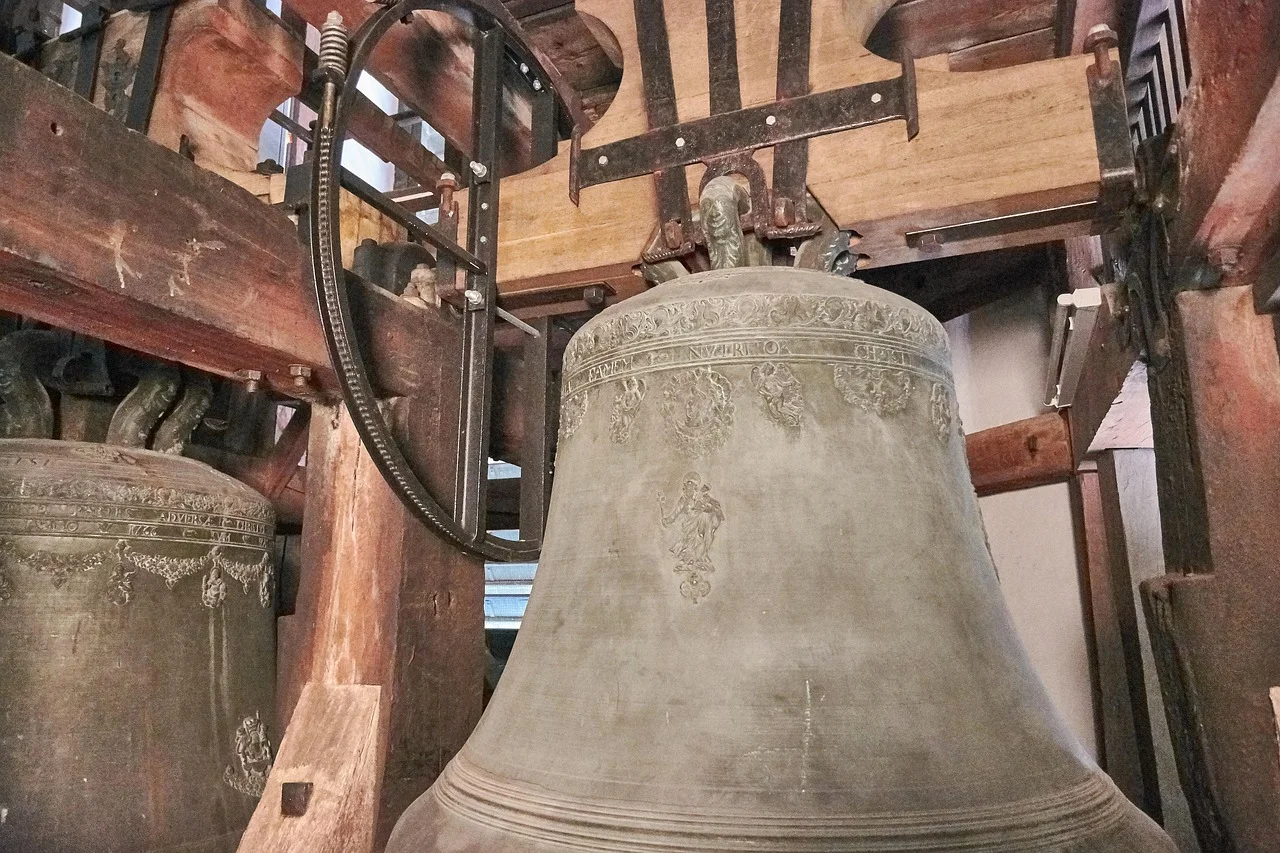
Across medieval Europe, the sound of church bells was more than a call to prayer or a marker of time. Bells carried voices of faith, authority, and memory that reached every corner of a community. Their inscriptions, often overlooked today, held layers of meaning that extended far beyond decoration.
These words, phrases, and symbols inscribed onto bronze metal revealed the fears, hopes, and identities of the people who cast and heard them.
The purpose of inscriptions
Medieval church bells were not merely tools but sacred objects, often consecrated in rituals resembling baptisms. The act of inscribing them with texts and images gave them personality and voice. Inscriptions were meant to identify the bell’s role, invoke divine protection, or dedicate it to a saint. At the same time, they served as public records, noting the donors who paid for their casting or the craftsmen who made them. Thus, inscriptions transformed bells into historical documents, carrying names and prayers long after those who inscribed them were gone.
Common religious formulas
A large proportion of inscriptions were invocations to God, Christ, or saints. Phrases such as “O Rex Gloriae, veni cum pace” (“O King of Glory, come with peace”) or “Sancta Maria, ora pro nobis” (“Holy Mary, pray for us”) were frequent. These formulas expressed the community’s reliance on divine intervention and reminded listeners that the bell’s sound was itself a prayer carried into the heavens. Some bells bore longer Latin verses, crafted in rhyme, that linked the ringing sound with the spiritual act of calling angels or dispelling evil spirits. For medieval people, the bell’s inscription was not silent—it resonated with every toll.
Protective meanings
Inscriptions often highlighted the belief that bells had apotropaic powers, meaning they could ward off evil or danger. Many bore phrases intended to repel storms, plague, or demons. One common inscription read “Fulgura frango” (“I break the lightning”), suggesting the bell could protect the village from destructive storms when rung. Another formula, “Vivos voco, mortuos plango, fulgura frango” (“I call the living, mourn the dead, break the lightning”), captured the triple function of bells in daily life. These inscriptions reveal the blending of religious devotion with practical concerns of survival in a world vulnerable to natural and spiritual threats.
Markers of identity and memory
Church bells also carried the memory of those who contributed to their making. Wealthy patrons, local guilds, or entire villages often had their names inscribed on the bronze. For donors, this was a way to ensure remembrance, as each toll of the bell symbolically honored their generosity. In some regions, inscriptions included the date and place of casting, embedding the bell within a specific community’s history. Bells thus functioned as monuments of identity, echoing not only prayers but also the pride of those who built and maintained the church.
Craftsmen and their signatures
Medieval bell founders were highly skilled artisans whose work was both technical and spiritual. Some left their own marks or names on the bells, either in modest signatures or elaborate inscriptions. These markings served as both a claim of authorship and a testament to the artisan’s faith. Inscriptions sometimes included images, such as crosses, decorative borders, or coats of arms, which reinforced the connection between craftsmanship, community, and divine service. For historians, these details provide rare evidence of medieval artisans who otherwise left few written records.
Symbolism of sound and word
The relationship between inscription and sound was deeply symbolic. Words written in bronze gained power when the bell was struck, as if each ring activated the inscription’s meaning. If the bell invoked a saint, the toll was believed to summon that saint’s intercession. If it declared protection against storms, villagers trusted that the ringing physically repelled clouds and lightning. The inscription thus transformed the bell into a living participant in the community’s spiritual and physical defense, merging text, sound, and faith into a single experience.
Regional variations
Different regions developed their own traditions of bell inscriptions. In France, poetic verses in Latin were especially common, while in England, short phrases such as “Ave Maria” dominated. German bells often carried rhymed couplets, reflecting the strong oral traditions of the region. Some Italian bells incorporated images of saints alongside their inscriptions, highlighting the artistic as well as textual nature of the medium. These variations reflect how local cultures shaped the ways communities expressed themselves through their bells, even while sharing broader Christian themes.
Hidden political and social messages
Not all inscriptions were purely devotional. In some cases, church bells carried subtle political meanings. Donors from noble families or wealthy guilds ensured their names were prominently displayed, turning the bell into a public declaration of status and influence. Bells inscribed with royal symbols or mottos reinforced political authority, reminding listeners that spiritual and temporal power were intertwined. In times of conflict, inscriptions could carry patriotic messages, declaring allegiance to rulers or cities. These layers of meaning transformed bells into instruments of both faith and social order.
The endurance of inscriptions
Unlike manuscripts or paintings, which could be lost, bells often endured for centuries, their inscriptions surviving fires, wars, and weathering. Even when cracked or recast, fragments of old inscriptions were sometimes preserved and incorporated into new bells, ensuring continuity of meaning. Today, these inscriptions provide valuable insights for historians, linguists, and archaeologists. They offer rare glimpses into local dialects, devotional practices, and even humor, as some bells carried playful verses. In this way, inscriptions remain as voices from the medieval past, speaking across time through the resonance of bronze.
Bells as voices of memory
The inscriptions on medieval church bells carried hidden meanings that combined devotion, protection, identity, and power. Each phrase or symbol transformed a lump of cast metal into a sacred voice that could pray, warn, and remind. They were texts not meant to be read in silence but to be heard in echoing sound, binding communities together in faith and shared experience.
When medieval people heard the bells ring, they were not just hearing bronze struck by a clapper—they were hearing words inscribed in metal, brought to life through sound. In this union of inscription and resonance, church bells became more than objects; they became voices of memory and meaning, still audible across the centuries.