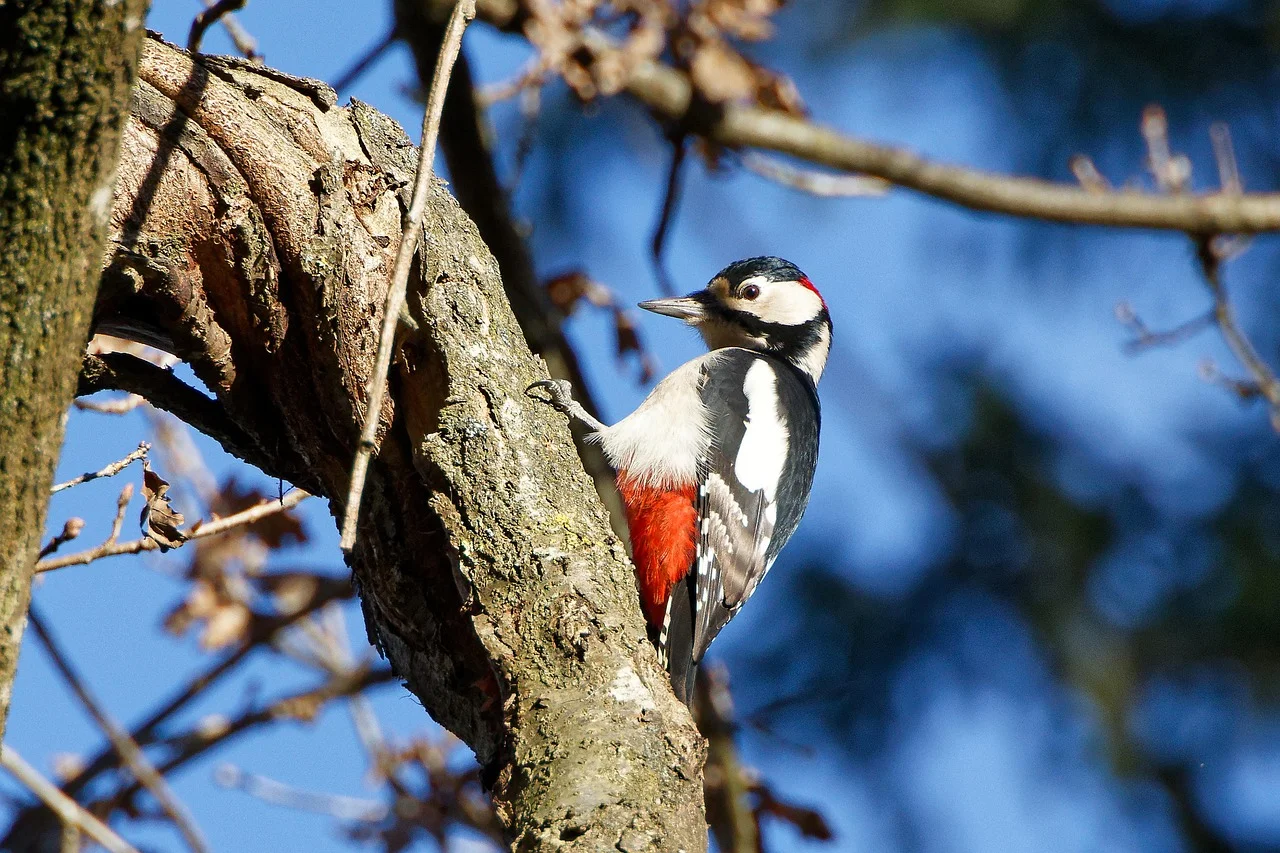
Few sights are as familiar in forests as that of a woodpecker rhythmically striking a tree, its beak pounding with remarkable speed and force. These birds can peck up to 20 times per second and deliver thousands of strikes in a single day. Each impact generates a deceleration that would, in human terms, cause a concussion or even severe brain injury.
Yet woodpeckers emerge unscathed, their precision and persistence undiminished. This extraordinary resilience has fascinated scientists for decades.
The scale of the challenge
When a woodpecker strikes a tree, its head experiences forces of up to 1,200 g’s. By comparison, a human concussion can occur at just 60–100 g’s. The bird’s skull and brain must therefore absorb or dissipate enormous amounts of energy. If not managed, such repeated shocks would cause traumatic brain injury. The fact that woodpeckers survive—and thrive—under these conditions highlights the sophistication of their protective mechanisms.
Specialized skull structure
The first line of defense lies in the structure of the woodpecker’s skull. Unlike humans, whose brains float in fluid that can allow them to move and collide with the skull walls during impact, the woodpecker’s brain is tightly packed within its cranium. This snug fit minimizes internal movement and reduces the likelihood of bruising. Additionally, the skull bones are thick but spongy, containing a network of tiny air pockets that act as shock absorbers, dispersing energy away from sensitive tissues.
Beak design and force distribution
The beak itself plays a crucial role in managing impact. A woodpecker’s upper and lower beak are slightly uneven in length. This asymmetry ensures that not all force is transmitted directly back to the skull during pecking. Instead, the force is distributed across the beak structure, lowering the stress experienced by the brain. Furthermore, the beak is composed of keratin and resilient bone, providing both strength and flexibility. The combination allows the beak to function like a spring, absorbing part of the shock before it reaches the skull.
Neck muscles as shock absorbers
Woodpeckers rely on powerful neck muscles to deliver rapid strikes, but those same muscles also protect the brain. Before impact, the muscles tense, stabilizing the head and controlling the angle of strike. This controlled movement reduces whiplash and prevents rotational forces, which are often more damaging than linear impact. By keeping the head aligned with the beak, woodpeckers ensure that the impact energy is directed into the tree rather than dispersed unpredictably through the skull.
The role of the hyoid bone
One of the most remarkable adaptations is the woodpecker’s elongated hyoid bone, a structure that supports the tongue. Unlike in most birds, the woodpecker’s hyoid wraps around the skull, extending from the beak, around the head, and anchoring near the nostrils. This unusual arrangement acts like a safety harness: it braces the skull, distributes impact forces, and helps stabilize the head during pecking. The hyoid also contributes to shock absorption, effectively acting as an internal suspension system.
Small brain size and orientation
Size and positioning also matter. The woodpecker’s brain is relatively small and smooth compared to that of humans. A smaller brain has less mass, meaning it experiences less inertia during sudden decelerations. Additionally, the brain is oriented so that the major axis of impact aligns with its strongest structural direction. This alignment reduces shear forces, which are a common cause of concussions in mammals. In evolutionary terms, the compact design of the woodpecker’s brain minimizes vulnerability to impact injury.
Behavioral strategies
In addition to anatomy, behavior helps reduce risks. Woodpeckers do not strike continuously without pause. They vary the rhythm and duration of their pecking, giving their bodies brief recovery moments. They also tend to target dead or decayed wood, which is softer and requires less force to penetrate. This selective pecking reduces the overall intensity of impacts while still enabling the birds to forage for insects or excavate nesting cavities.
Scientific studies and debates
Despite clear evidence of protective adaptations, scientists have debated whether woodpeckers might still experience some form of brain injury over time. A study in 2018 discovered traces of tau protein in woodpecker brains, a substance associated with brain damage in humans. However, it is not yet clear whether the presence of tau indicates harm in birds or serves a protective function. Some researchers suggest that woodpeckers may have evolved to use tau differently, possibly as reinforcement for brain tissues under repetitive stress. This ongoing research reflects the complexity of translating human medical concerns to avian physiology.
Applications for human technology
The woodpecker’s resilience has inspired engineers and medical researchers seeking to design better shock-absorbing systems. For instance, studies of their beak and skull structures have influenced the development of improved helmets for sports and cycling. Car safety engineers have also examined how woodpeckers manage impact to design crumple zones that absorb energy more effectively. Even aerospace research has drawn from woodpecker adaptations, using their biological models to improve designs for vibration resistance in spacecraft equipment.
The evolutionary trade-off
While woodpeckers are remarkably adapted to withstand impact, these features come at a cost. Their skulls are specialized for pecking, limiting other feeding strategies. Their strong neck muscles and reinforced skulls require significant energy investment, influencing their body design and behavior. Evolution has effectively traded versatility for specialization, producing birds that are highly efficient in one ecological niche but less adaptable in others. This trade-off highlights the precision of natural selection in shaping survival strategies.
Masters of impact
Woodpeckers avoid brain damage through a combination of structural, physiological, and behavioral adaptations: tightly fitting brains, shock-absorbing skulls, resilient beaks, bracing hyoid bones, and controlled strikes all contribute to their resilience. Far from being fragile creatures at risk with every strike, woodpeckers embody evolutionary engineering at its finest. Their adaptations not only allow them to thrive in their ecological niche but also provide valuable insights for human innovation. Each rapid peck against a tree is a demonstration of nature’s ability to solve problems with elegance and precision.