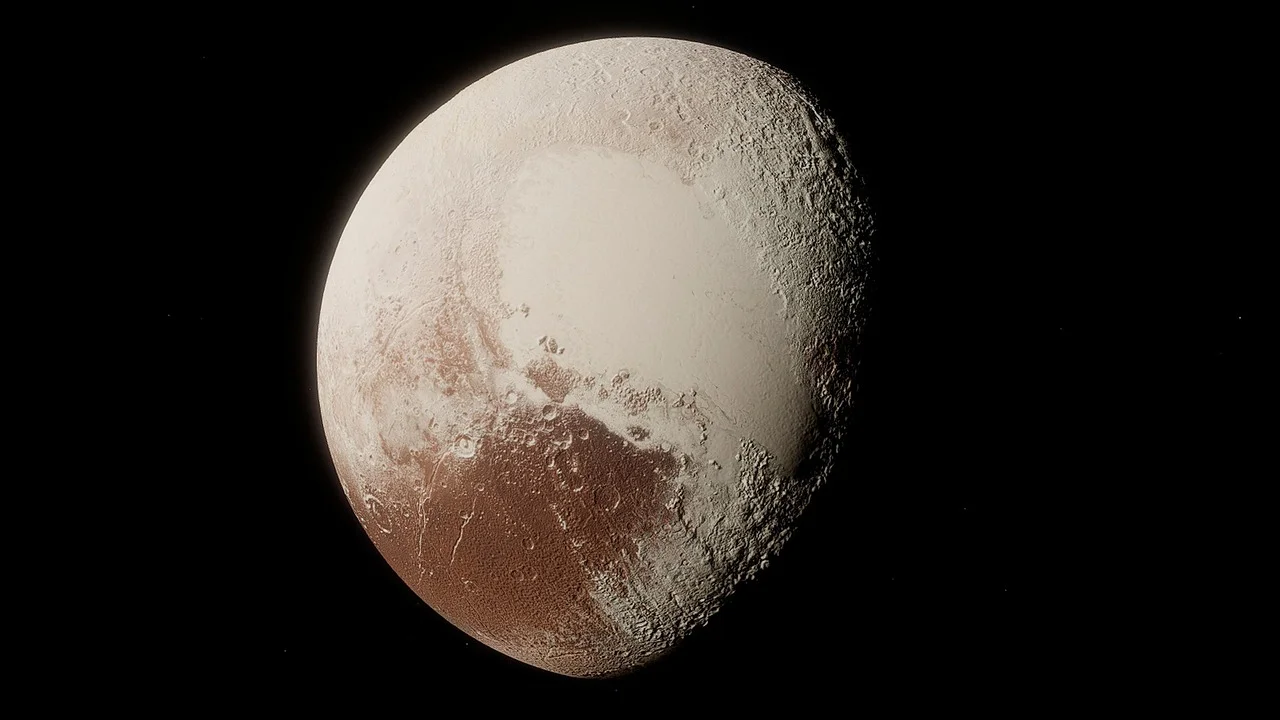
In 2006, Pluto was famously reclassified from a planet to a “dwarf planet,” sparking debates not only in the scientific community but also among the general public. Once celebrated as the ninth planet of our solar system, Pluto’s new status raised questions about what actually defines a planet and why some celestial bodies occupy this in-between category.
The definition of a planet
For centuries, “planet” was a loosely defined term that applied to any large object orbiting the Sun. This changed in 2006, when the International Astronomical Union (IAU) introduced a precise definition. According to the IAU, a celestial body must meet three criteria to qualify as a planet:
- It must orbit the Sun.
- It must have sufficient mass to be nearly round in shape, caused by its own gravity.
- It must have cleared its orbital path of other debris.
Pluto meets the first two conditions but fails the third, because it shares its orbit with other icy bodies in the Kuiper Belt. As a result, it was reclassified as a dwarf planet.
The criteria for a dwarf planet
Dwarf planets were formally defined to accommodate objects like Pluto. To qualify as a dwarf planet, a celestial body must:
- Orbit the Sun.
- Be massive enough to form a nearly round shape under its own gravity.
- Not have cleared its orbital neighborhood of other objects.
Unlike moons, dwarf planets orbit the Sun directly rather than orbiting a planet. This definition creates a category distinct from the eight planets, recognizing that bodies like Pluto have unique characteristics without diminishing their scientific importance.
Pluto’s characteristics
Pluto exemplifies the features of a dwarf planet. It is about 2,377 kilometers in diameter—smaller than Earth’s Moon—but still large enough for gravity to mold it into a spherical shape. Its orbit is highly eccentric, meaning it is elongated and tilted compared to the nearly circular paths of the planets. At times, Pluto’s orbit even brings it closer to the Sun than Neptune. These unusual orbital traits already set Pluto apart from regular planets, highlighting why classification matters.
The Kuiper Belt connection
One of the most significant differences between dwarf planets and regular planets lies in their location. Many dwarf planets, including Pluto, Eris, Haumea, and Makemake, are located in the Kuiper Belt—a vast region of icy bodies beyond Neptune. This area is thought to contain remnants from the early solar system, preserved in a frozen state. The presence of many similar objects in Pluto’s neighborhood reinforces the idea that it has not cleared its orbit, one of the key distinctions from planets.
The importance of “clearing the neighborhood”
The third criterion of planetary status—clearing the orbital neighborhood—is central to understanding why Pluto is different. Large planets like Earth and Jupiter dominate their orbits, either by absorbing or ejecting smaller objects over time. Dwarf planets, however, coexist with other bodies, indicating they lack the gravitational influence to control their region. This distinction marks a difference in cosmic “authority”: regular planets act as gatekeepers of their orbits, while dwarf planets share space with their peers.
Comparisons with regular planets
When comparing dwarf planets to regular planets, several contrasts emerge:
- Size – Dwarf planets are generally much smaller. Pluto, for instance, is only about 18% the mass of Earth’s Moon.
- Orbit – Dwarf planets often have eccentric and tilted orbits, unlike the stable, near-circular paths of planets.
- Orbital dominance – Regular planets clear their orbits of debris; dwarf planets do not.
Despite these differences, both categories share characteristics such as being spherical and orbiting the Sun, which explains why reclassification was controversial among the public.
Other examples of dwarf planets
Pluto is not alone in this category. Several other recognized dwarf planets include:
- Eris – Discovered in 2005, slightly smaller than Pluto but more massive, located in the scattered disc region beyond the Kuiper Belt.
- Haumea – Known for its elongated shape and fast rotation, as well as a ring system, an unusual feature for a dwarf planet.
- Makemake – Another Kuiper Belt object, with a bright, methane-rich surface.
- Ceres – The only dwarf planet located in the asteroid belt between Mars and Jupiter, and the first to be visited by a spacecraft.
These bodies demonstrate the diversity of dwarf planets, reinforcing the idea that they deserve recognition as a distinct category of celestial objects.
Scientific significance of dwarf planets
Though smaller and less dominant than regular planets, dwarf planets are scientifically important. They are thought to preserve information about the early solar system, acting as time capsules of its formation. Studying their composition, atmospheres, and surfaces helps scientists understand planetary evolution. For example, data from NASA’s New Horizons mission revealed that Pluto has mountains of water ice, nitrogen glaciers, and possible subsurface oceans, surprising scientists with its geological activity. Such findings challenge assumptions that small, distant worlds are inert.
Cultural impact and public perception
Pluto’s reclassification captured the public imagination, sparking campaigns and debates about whether it should still be called a planet. The controversy reveals how deeply people connect with celestial bodies as symbols of exploration and identity. While scientists rely on strict definitions, the cultural attachment to Pluto demonstrates that astronomy is not only about science but also about human emotion and perspective. In this sense, dwarf planets serve as reminders that categories can evolve as knowledge expands.
Small worlds, big questions
Dwarf planets like Pluto differ from regular planets primarily because they lack the gravitational dominance to clear their orbits, despite sharing features such as spherical shape and direct orbit around the Sun. These small worlds highlight the diversity of celestial bodies and force us to reconsider how we classify objects in space. More than a matter of labels, the study of dwarf planets enriches our understanding of the solar system’s history, structure, and potential for discovery. In exploring why Pluto is different, we uncover not just a definition but a deeper appreciation of the complexity of the universe.