Among the countless phenomena that populate the cosmos, few are as spectacular—or as mysterious—as gamma-ray bursts (GRBs). Discovered accidentally in the late 1960s, these bursts of high-energy radiation can outshine entire galaxies for a few fleeting seconds.
They release more energy in that short span than our Sun will emit in its entire 10-billion-year lifetime. Astronomers now regard them as the brightest events in the universe, yet their origins, mechanisms, and implications continue to be areas of active research.
The discovery of gamma-ray bursts
Gamma-ray bursts were first detected by U.S. military satellites designed to monitor nuclear tests. Instead of finding human-made explosions, the instruments picked up intense flashes of gamma radiation coming from deep space. These mysterious bursts appeared randomly in the sky, without warning, and lasted anywhere from milliseconds to several minutes. For decades, their cause remained unknown, sparking debates and theories about cataclysmic cosmic events.
What are gamma rays?
Gamma rays are the most energetic form of electromagnetic radiation, with wavelengths shorter than X-rays and capable of carrying immense amounts of energy. Unlike visible light, gamma rays cannot be seen by the human eye or detected by ground-based telescopes, as Earth’s atmosphere blocks them. Special instruments aboard satellites are required to capture their signals. The fact that gamma-ray bursts emit vast quantities of this high-energy radiation is the first clue to their extraordinary nature.
Two main types of gamma-ray bursts
Astronomers categorize gamma-ray bursts into two primary classes based on their duration:
- Short-duration bursts – lasting less than two seconds, often linked to the collision and merger of neutron stars or a neutron star with a black hole.
- Long-duration bursts – lasting from a few seconds to several minutes, usually associated with the collapse of massive stars into black holes, often accompanied by supernovae.
These two mechanisms involve some of the most violent processes in the universe, explaining why GRBs release such extraordinary amounts of energy.
Energy on an unimaginable scale
To grasp the power of a gamma-ray burst, consider this: in just seconds, a GRB can emit as much energy as the Sun will produce over its entire lifespan. Some bursts briefly outshine all the stars in their host galaxies combined. The energy released is focused into narrow jets traveling near the speed of light. When one of these jets happens to be directed toward Earth, astronomers detect a brilliant flash of gamma rays that eclipses any other cosmic event in brightness.
The role of relativistic jets
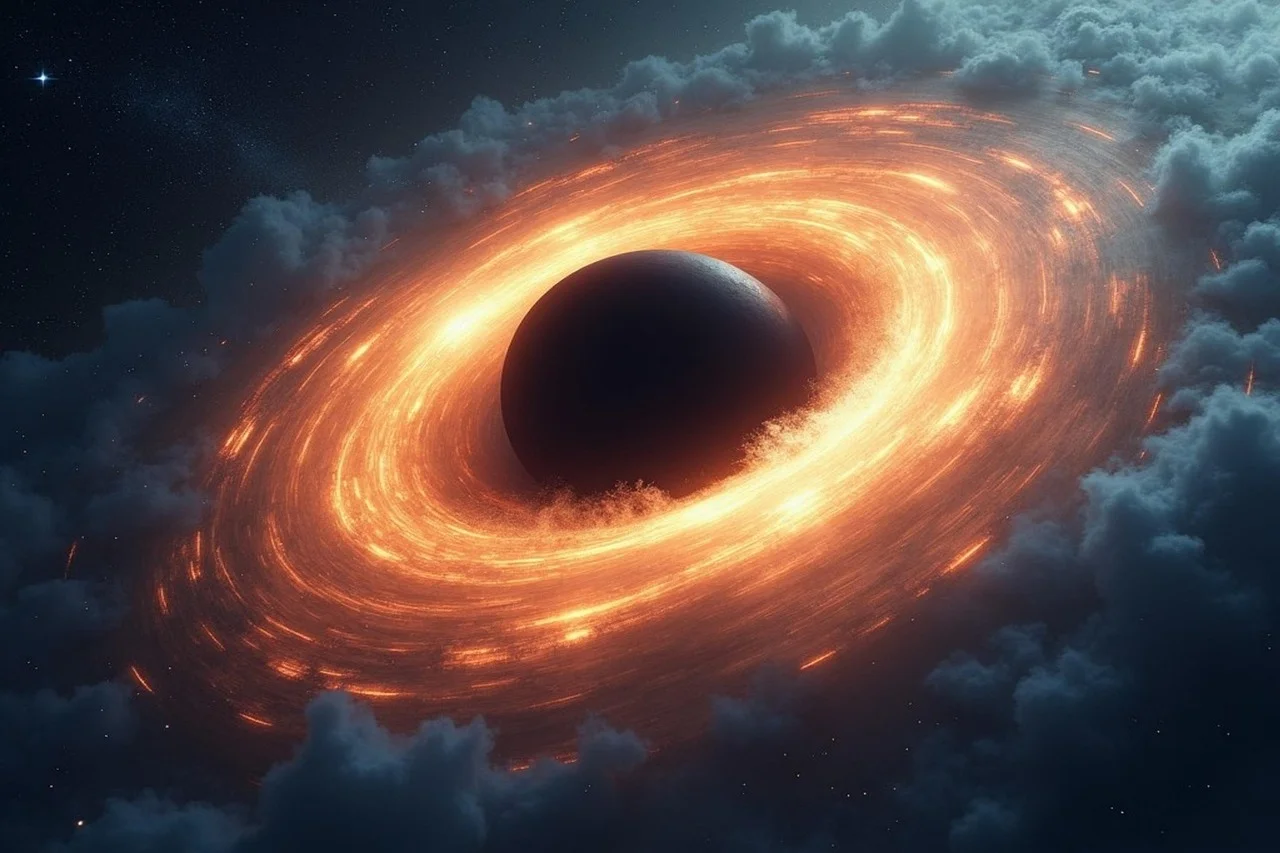
The extreme brightness of GRBs is partly explained by their relativistic jets. During the collapse of a star or the merger of compact objects, matter is funneled into narrow streams and ejected at velocities close to the speed of light. This concentration of energy into beams, rather than spreading it in all directions, makes the event appear far brighter to observers aligned with the jet. The phenomenon is comparable to focusing light through a magnifying glass—except on cosmic scales with incomprehensible energy.
Afterglows and multi-wavelength observations
Although the initial gamma-ray flash is brief, GRBs often leave behind an afterglow observable across the electromagnetic spectrum, including X-rays, visible light, and radio waves. Studying these afterglows has allowed astronomers to pinpoint the locations of GRBs, measure their distances, and confirm their association with distant galaxies. These afterglows also provide insight into the surrounding environment, helping scientists understand how GRBs interact with interstellar material.
Distances and cosmic significance
Gamma-ray bursts are often detected billions of light-years away, meaning they occurred when the universe was still young. Their visibility across such vast distances demonstrates their staggering luminosity. For astronomers, this makes GRBs valuable tools for probing the early universe. By studying the light they emit, researchers can learn about star formation, galaxy evolution, and the distribution of matter in the cosmos during its formative epochs.
The threat to life
While gamma-ray bursts are usually too distant to pose direct danger to Earth, their destructive potential is immense. If a GRB were to occur within a few thousand light-years of our planet and its jet pointed directly at us, the radiation could strip away Earth’s ozone layer, exposing life to lethal ultraviolet rays from the Sun. Some scientists have speculated that GRBs may have contributed to mass extinction events in Earth’s history, although definitive evidence is lacking. This potential underscores the raw power of these cosmic phenomena.
Why GRBs are the brightest events
Several factors combine to make GRBs the brightest known events in the universe:
- Extreme origins – The collapse of massive stars or the merger of neutron stars unleashes energy on colossal scales.
- Relativistic jets – Energy is concentrated into narrow beams, dramatically increasing apparent brightness.
- High-energy radiation – Emission in the gamma-ray spectrum means enormous energy output per photon compared to visible light.
- Cosmic distances – Their detectability across billions of light-years testifies to their luminosity.
These combined features distinguish GRBs from supernovae or quasars, making them the most dazzling explosions observable in the universe.
Scientific challenges and future research
Despite decades of study, many questions about GRBs remain. How exactly do jets form and remain so narrowly focused? What role do magnetic fields play in shaping them? Why do some massive stars produce GRBs while others collapse quietly into black holes? To answer these questions, astronomers rely on an international network of satellites and ground-based observatories. Future missions, such as more sensitive gamma-ray detectors and gravitational wave observatories, promise to uncover even deeper connections between GRBs, stellar evolution, and fundamental physics.
Gamma-ray bursts as cosmic beacons
Gamma-ray bursts stand as nature’s ultimate fireworks, marking moments of extraordinary transformation in the universe. Their brightness surpasses every other known phenomenon, illuminating not only the galaxies that host them but also the mysteries of cosmic evolution itself. As scientists continue to study these powerful events, GRBs serve as both challenges to our understanding of physics and opportunities to peer deeper into the history of the cosmos. In their fleeting brilliance, they remind us of the universe’s ability to astonish, disrupt, and reveal its secrets in dazzling bursts of light.