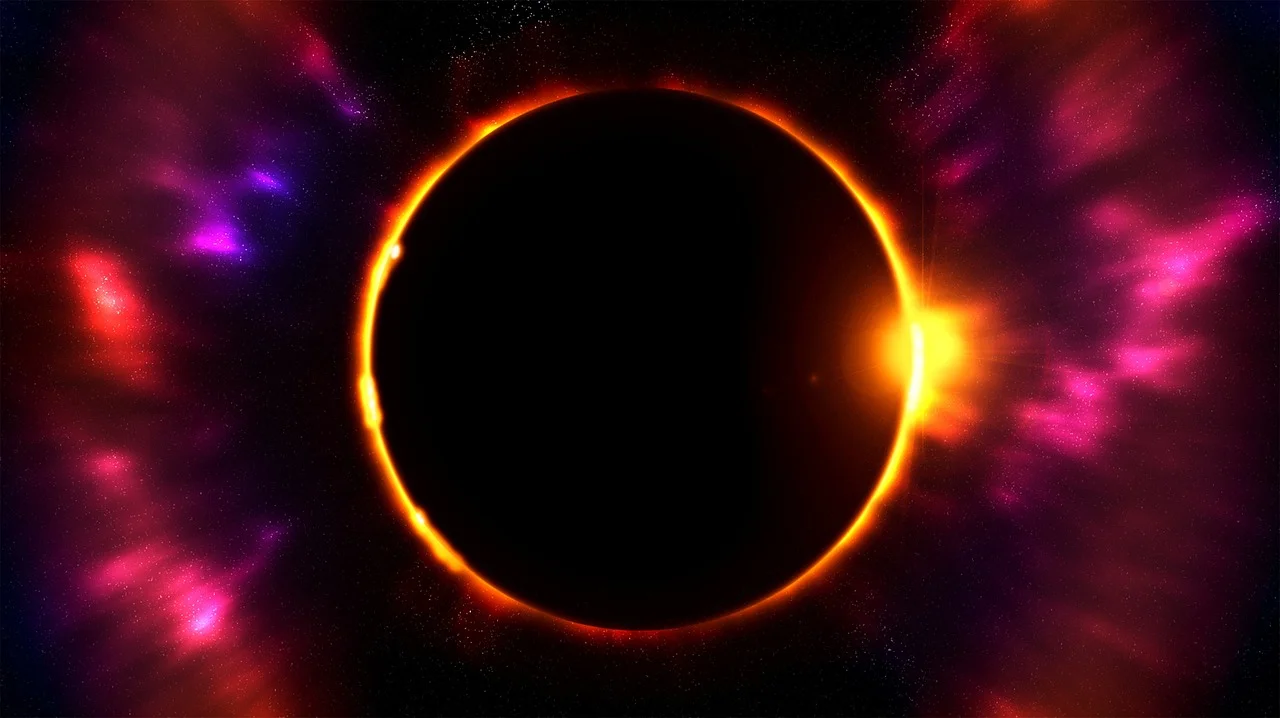
Solar eclipses have fascinated humanity for thousands of years, often inspiring myths, awe, and even fear. Beyond their cultural significance, eclipses offer rare opportunities for modern science. When the Moon passes directly between the Earth and the Sun, blocking its blinding light, researchers can study parts of the Sun that are usually hidden from view.
These fleeting moments, lasting only a few minutes in any given location, provide valuable data that has helped shape our understanding of the Sun’s structure, atmosphere, and influence on Earth. Solar eclipses remain some of the most powerful natural laboratories for astronomy.
The challenge of studying the Sun
Unlike distant stars, the Sun is both near and overwhelmingly bright. Its brilliance makes it dangerous to observe directly without protective equipment. Even sophisticated telescopes struggle to block its glare while capturing the faint light of its outer layers. Instruments called coronagraphs can mimic an eclipse by using a disk to cover the Sun’s disk artificially, but these devices often scatter light and reduce image clarity. Natural eclipses, by contrast, create perfect conditions, allowing scientists to view the Sun’s outer layers in unprecedented detail.
Revealing the solar corona
The most striking feature visible during a total solar eclipse is the solar corona—the Sun’s outer atmosphere. Normally invisible against the Sun’s glare, the corona appears as a halo of pearly light extending millions of kilometers into space. Studying the corona during eclipses has revealed its dynamic structures, shaped by powerful magnetic fields. Scientists discovered that the corona is far hotter than the Sun’s surface, reaching millions of degrees Celsius, a mystery still actively researched. Observations during eclipses have helped refine models of coronal heating, solar wind, and space weather phenomena.
Tracing solar winds and magnetic fields
Solar winds—streams of charged particles flowing outward from the Sun—originate in the corona. By photographing and analyzing coronal structures during eclipses, scientists can trace the paths of these winds and better understand how they interact with planetary magnetic fields, including Earth’s. This knowledge is critical for predicting geomagnetic storms that can disrupt satellites, communication networks, and power grids. Eclipse observations provide essential insights into the invisible magnetic scaffolding that drives solar activity.
Discoveries in solar physics
Solar eclipses have historically played key roles in advancing solar physics. In the 19th century, spectroscopic studies of eclipse light led to the discovery of helium—an element first identified on the Sun before being found on Earth. Later eclipses revealed new insights into the composition and structure of the solar atmosphere. Each eclipse offered fresh data, often sparking advances that reshaped astronomy. Even in the era of space telescopes, eclipses remain invaluable checkpoints for calibrating instruments and validating theoretical models.
Eclipses and general relativity
Perhaps the most famous scientific experiment involving a solar eclipse occurred in 1919, when Sir Arthur Eddington led an expedition to test Albert Einstein’s theory of general relativity. During the eclipse, scientists photographed stars near the Sun’s edge. According to Einstein, the Sun’s gravity should bend the path of starlight. The results confirmed his predictions, providing one of the first major proofs of general relativity. This event demonstrated how eclipses could serve as cosmic experiments, connecting solar observations to the broader laws of physics.
Modern instruments and eclipse expeditions
Today, scientists use eclipses to test high-resolution cameras, spectrographs, and polarimeters. By carefully measuring coronal light, they can study the chemical composition, density, and temperature of different solar layers. Eclipse expeditions, often involving international teams, set up telescopes along the path of totality to maximize observation time. With digital imaging, researchers now capture unprecedented details of coronal dynamics, improving predictions of solar storms and enhancing our ability to forecast space weather.
Biological and atmospheric effects
Eclipses not only provide opportunities to study the Sun but also its influence on Earth. During totality, temperatures drop, winds shift, and animals behave as though night has fallen. Scientists use these conditions to investigate how sudden changes in solar radiation affect local ecosystems and atmospheric processes. By analyzing these short-term effects, researchers gain insight into how solar variability shapes climate and life on Earth.
Comparisons with artificial coronagraphs
Space-based coronagraphs, such as those aboard NASA’s SOHO and ESA’s Solar Orbiter missions, provide continuous observations of the corona. Yet these instruments face limitations due to scattered light and design constraints. Eclipses offer a natural benchmark for evaluating their accuracy. By comparing eclipse data with satellite images, scientists can refine calibration methods and improve long-term monitoring. In this way, eclipses complement rather than replace space missions, bridging the gap between natural events and continuous observation.
Public engagement and scientific outreach
Beyond their scientific value, eclipses serve as powerful tools for public engagement. Millions of people witness them, often sparking interest in astronomy and science more broadly. During major eclipses, researchers collaborate with educators and citizen scientists to gather data across wide geographic regions. Public involvement in eclipse science has expanded with digital tools, allowing ordinary observers to contribute valuable photographs and environmental measurements to professional studies. These collaborations strengthen the link between scientific research and cultural experience.
Challenges and limitations
Despite their value, eclipses present challenges. Totality lasts only a few minutes, forcing scientists to work with extraordinary precision. Weather conditions can disrupt years of preparation, clouding the sky at critical moments. Additionally, eclipses occur only a few times per year, often in remote regions, making large-scale observations difficult. These constraints explain why space missions remain essential for continuous study, even as eclipses provide irreplaceable bursts of data.
Solar eclipses as windows into stellar mysteries
Every solar eclipse serves as a reminder that our nearest star still holds profound mysteries. From unveiling the corona to testing the laws of physics, eclipses transform fleeting moments of shadow into opportunities for discovery. They allow scientists to glimpse phenomena that remain hidden in ordinary daylight and continue to inspire both research and wonder. In bridging the gap between natural spectacle and scientific exploration, solar eclipses stand as powerful windows into the enduring mysteries of the Sun and its influence on our world.