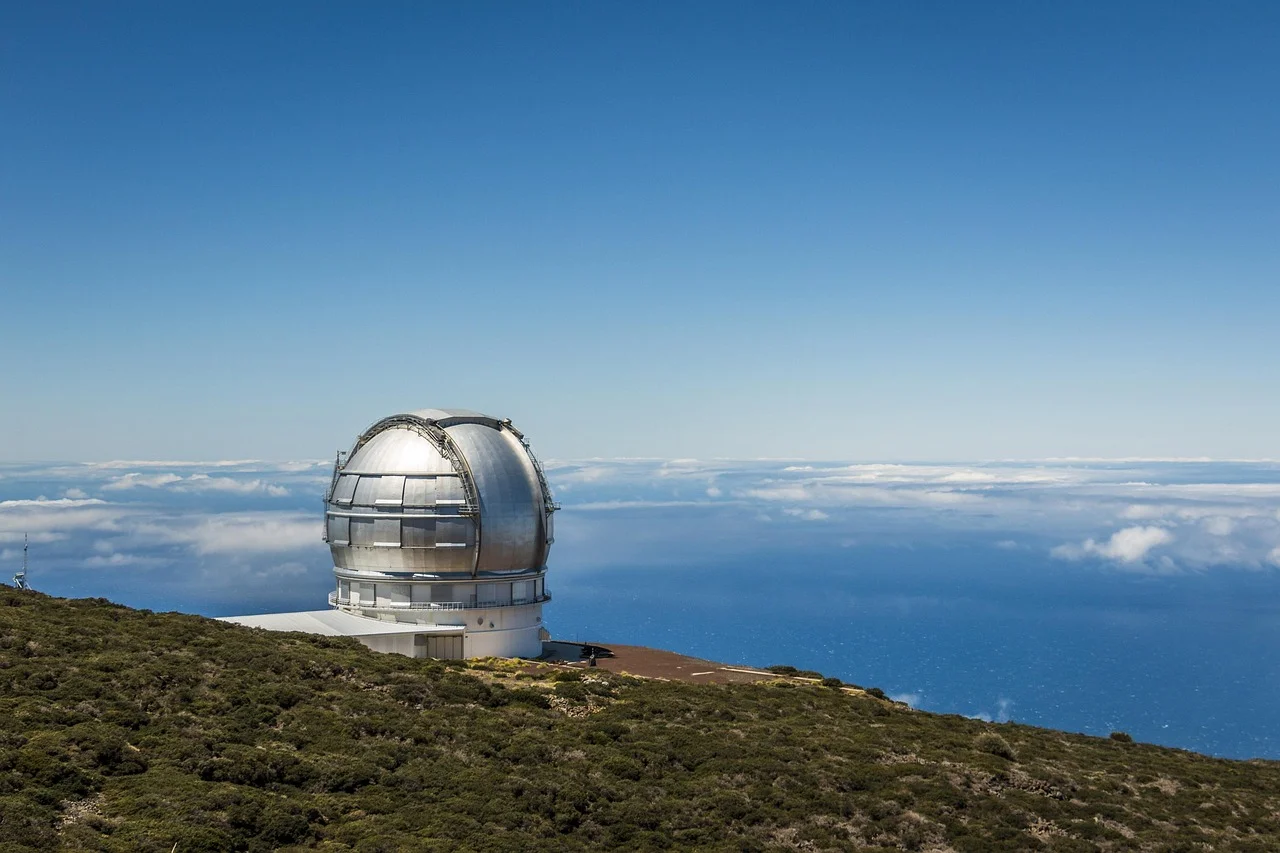
When we think of astronomy, images of massive telescopes gazing into the night sky often come to mind. But these observatories are not placed randomly. Many of the world’s most advanced astronomical facilities are located high on mountain tops or deep within remote deserts.
Sites like Mauna Kea in Hawaii, the Atacama Desert in Chile, and the Canary Islands in Spain are home to some of the most powerful telescopes ever built. The question is: why do scientists consistently choose such extreme and isolated environments for exploring the universe?
The problem of atmospheric interference
Earth’s atmosphere, while vital for life, is a constant obstacle for astronomy. Light traveling from distant stars and galaxies must pass through layers of air before reaching a telescope. Along the way, it encounters turbulence, dust, and water vapor that scatter or distort the signals. This effect, known as “atmospheric seeing,” causes stars to appear to twinkle and reduces the sharpness of images. By placing observatories at high altitudes or in dry deserts, astronomers minimize the amount of atmosphere above them, allowing clearer and more detailed observations.
Altitude and thinner air
Mountain tops provide a significant advantage because of their altitude. At several thousand meters above sea level, observatories sit above much of the lower atmosphere where most turbulence and weather occur. The thinner air reduces the scattering of light and allows telescopes to capture finer details. Mauna Kea, for instance, rises nearly 4,200 meters above sea level, placing telescopes above 40 percent of Earth’s atmosphere. The reduced air density also improves transparency in infrared and submillimeter wavelengths, which are particularly vulnerable to atmospheric absorption.
Deserts and dry air
While altitude helps with turbulence, deserts solve another major problem: water vapor. Moisture in the air absorbs infrared and microwave radiation, blocking key parts of the electromagnetic spectrum. Deserts like Chile’s Atacama are among the driest places on Earth, with some regions going years without measurable rainfall. This dryness creates near-ideal conditions for observing in infrared and radio wavelengths. The Atacama Large Millimeter/submillimeter Array (ALMA), located at 5,000 meters, takes advantage of both altitude and dryness to capture unprecedented images of galaxies and star-forming regions.
Clear skies and stable weather
Telescopes require consistent access to the sky, and deserts or high mountain regions provide it. These areas often experience more than 300 clear nights per year. Stable weather reduces interruptions caused by storms, clouds, or humidity. For example, the Canary Islands, where the Roque de los Muchachos Observatory is located, benefit from an inversion layer that keeps clouds below the mountaintops, offering remarkably clear skies. Such stability is crucial for long-term observations and projects that require continuous monitoring of celestial objects.
Isolation from light pollution
Modern cities produce vast amounts of artificial light that scatter in the atmosphere and obscure the night sky. Light pollution is one of the biggest threats to astronomy, making it impossible to see faint stars or distant galaxies. By placing observatories in remote deserts or on mountain tops far from urban centers, astronomers escape the glow of city lights. The darkness of these locations allows telescopes to detect faint signals that would otherwise be drowned out. The night skies of places like the Atacama are so pristine that they have become destinations for both professional astronomers and amateur stargazers.
Radio astronomy and quiet zones
Not all observatories focus on visible light. Radio telescopes detect signals from distant galaxies, pulsars, and cosmic background radiation. These instruments are highly sensitive to interference from human technologies such as cell phones, satellites, or radio broadcasts. Remote deserts and isolated mountain valleys offer protection from this “radio noise.” In some areas, governments establish “radio quiet zones” where electronic transmissions are restricted to preserve the scientific integrity of observations. The Green Bank Observatory in West Virginia, for instance, operates in such a zone, allowing it to detect faint cosmic signals without interference.
The importance of atmospheric stability
Beyond simple altitude and dryness, astronomers seek sites with stable atmospheric conditions. Even at high altitudes, turbulence in the upper atmosphere can blur images. Locations with laminar, or smoothly flowing, air currents are especially valuable. Mauna Kea is prized not only for its altitude but also for the stability of the Pacific air masses around it, which provide exceptional seeing conditions. Similarly, the Atacama Plateau benefits from steady winds and minimal turbulence, making it one of the best places on Earth for precision astronomy.
Accessibility versus remoteness
While isolation is valuable, it also poses challenges. Building observatories in deserts or atop mountains requires significant engineering, logistics, and financial resources. Roads, power supplies, and housing for staff must be constructed in inhospitable environments. At the same time, accessibility remains important—researchers and technicians must be able to reach the telescopes for maintenance and upgrades. The balance between remoteness for ideal conditions and accessibility for practical operations is a constant factor in site selection.
Comparisons with space telescopes
One might ask: if Earth’s atmosphere causes so many problems, why not place all observatories in space? Space telescopes, such as the Hubble Space Telescope and the James Webb Space Telescope, avoid atmospheric interference entirely. However, they are enormously expensive to launch and maintain, and repairs are often impossible once in orbit. Ground-based observatories, despite their limitations, offer flexibility, lower costs, and the ability to upgrade instruments regularly. By carefully choosing locations on Earth, astronomers achieve near-space quality observations at a fraction of the cost.
Environmental and cultural considerations
Constructing observatories in deserts and on mountains also raises environmental and cultural concerns. The sites often overlap with fragile ecosystems or hold spiritual significance for local communities. For example, Mauna Kea is considered sacred by many Native Hawaiians, sparking debates about the balance between scientific progress and cultural respect. Similarly, desert observatories must take care not to disrupt delicate environments. Modern astronomy increasingly recognizes the need to engage with local communities and minimize environmental impact when planning observatory projects.
Mountain tops and deserts as gateways to the cosmos
The placement of astronomical observatories is the result of careful scientific reasoning. High mountain tops and dry deserts offer the clearest, darkest, and most stable skies on Earth, allowing telescopes to peer deeper into the universe than would otherwise be possible.
By minimizing atmospheric interference, escaping light pollution, and avoiding technological noise, these locations serve as gateways to cosmic discovery. Each observatory perched on a mountain ridge or desert plateau represents humanity’s determination to push past natural limitations and reach for the stars.