Comets have fascinated observers for thousands of years. Once regarded as omens or celestial mysteries, they are now understood through the lens of astronomy as icy visitors from the outer regions of the solar system. Among their most striking features are the long, glowing tails that trail behind them as they approach the Sun.
But how exactly do these tails form? The process is a remarkable combination of physics, chemistry, and interaction with solar forces, transforming a relatively small icy body into a spectacular beacon visible across the night sky.
The structure of a comet
To understand how comets develop tails, it is important to examine their composition. A comet is often described as a “dirty snowball,” consisting primarily of water ice mixed with frozen gases such as carbon dioxide, carbon monoxide, methane, and ammonia, along with dust and rocky material. At its core lies the nucleus, typically only a few kilometers across. When far from the Sun, the nucleus remains frozen and inert, appearing dark and unremarkable. It is only when a comet travels closer to the Sun that its dramatic transformation begins.
The role of solar heating
As a comet approaches the inner solar system, sunlight warms its icy nucleus. This warming does not simply melt the ice but causes sublimation, a process in which solid ice transforms directly into gas without becoming liquid. Sublimation releases trapped gas and dust particles, creating a glowing cloud around the nucleus known as the coma. The coma can extend thousands of kilometers and serves as the source material for the comet’s tails. Thus, the first step in tail formation begins with solar energy unlocking the volatile materials within the nucleus.
The two main types of comet tails
Comets typically display two distinct tails: the ion tail and the dust tail. Each is created by different physical processes, though they often appear together.
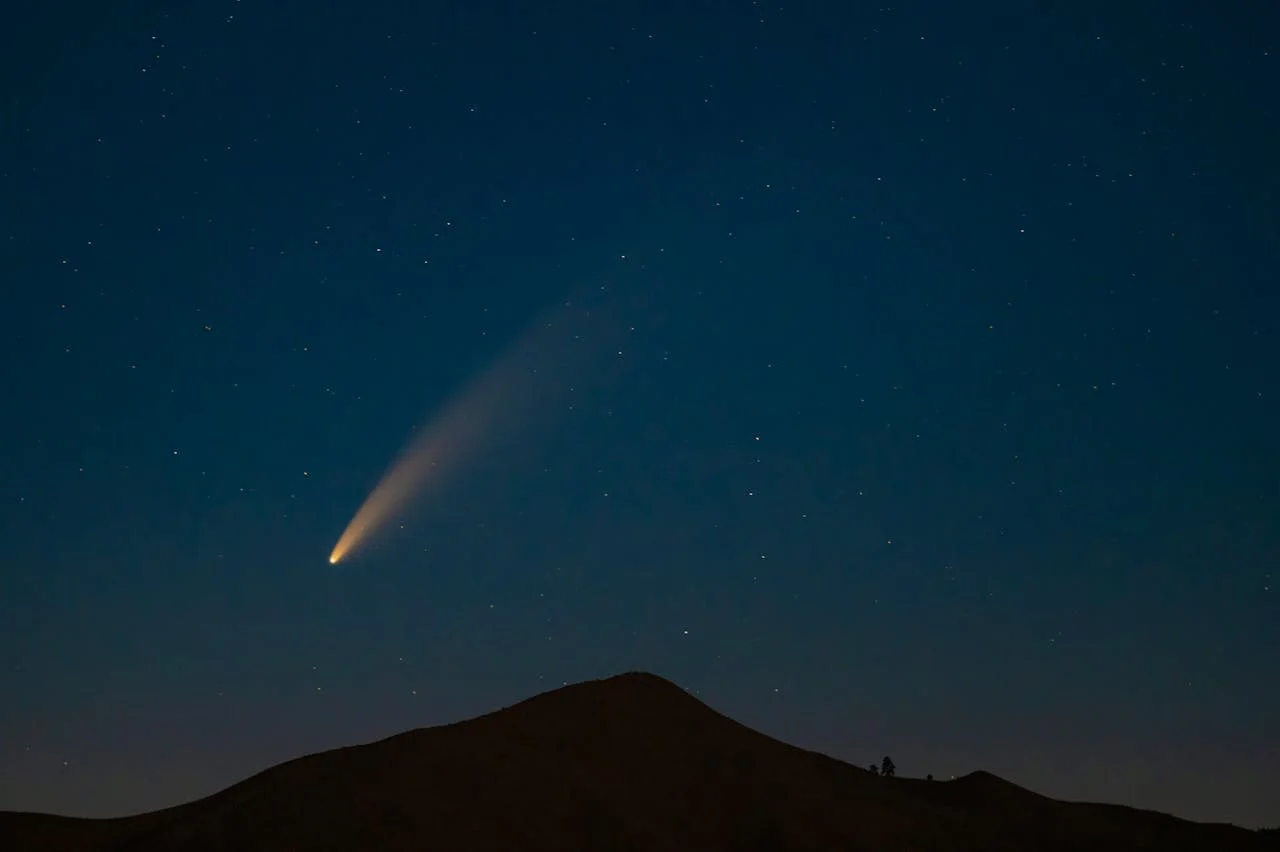
- The ion tail forms when gases in the coma become ionized, meaning they lose electrons under the influence of solar ultraviolet radiation. These charged particles are swept away by the solar wind, a stream of charged particles constantly flowing outward from the Sun. As a result, the ion tail always points directly away from the Sun, regardless of the comet’s direction of travel. It often appears bluish due to emissions from ionized carbon monoxide.
- The dust tail develops from small solid particles released during sublimation. Unlike ions, dust particles are pushed away by radiation pressure from sunlight. Because they are heavier and less influenced by the solar wind, dust particles tend to form a broader, curved tail that lags behind the comet’s trajectory. This tail usually appears yellowish or white, as it reflects sunlight.
The combination of these two tails creates the iconic image of a comet streaking through space.
Why comets only show tails near the Sun
Comets spend most of their lifetimes far from the Sun, in distant reservoirs like the Kuiper Belt or the Oort Cloud. At such distances, solar radiation is too weak to trigger sublimation. As a result, the comet remains frozen and invisible. Only when gravitational perturbations send a comet into the inner solar system does the increased solar heat activate sublimation and tail formation. This explains why tails are temporary features, appearing only during a comet’s close passage to the Sun.
The influence of the solar wind
The solar wind plays a critical role in shaping comet tails, especially the ion tail. Flowing at speeds of hundreds of kilometers per second, this stream of charged particles interacts directly with the comet’s ionized gases. The interaction can sometimes create structures such as ripples, disconnections, or kinks in the ion tail, visible even from Earth with powerful telescopes. These variations provide scientists with insights into both the comet’s activity and the changing conditions of the solar wind.
Differences between short-period and long-period comets
Not all comets display tails with equal brilliance. Short-period comets, which orbit the Sun in less than 200 years, often lose much of their volatile material after repeated passes. Their tails may appear faint or even absent after many orbits. Long-period comets, originating from the distant Oort Cloud and entering the inner solar system for the first time, often exhibit dramatic tails because their ices are still pristine. Famous examples like Comet Hale-Bopp and Comet NEOWISE showed bright, extended tails visible without telescopes, captivating millions of observers worldwide.
Cometary tails and historical significance
Before the rise of modern astronomy, comet tails were interpreted in symbolic or superstitious ways. Their sudden appearance in the sky was often associated with change, disaster, or divine intervention. The great length and brightness of their tails contributed to this perception of comets as otherworldly messengers. Today, while the mystery has been explained scientifically, the visual impact of a comet tail remains awe-inspiring and continues to draw attention whenever a bright comet becomes visible.
Scientific insights from comet tails
The study of comet tails provides more than visual spectacle; it also offers valuable scientific information. By analyzing the composition of tails through spectroscopy, scientists can determine what gases and dust are present. These measurements provide clues about the early solar system, as comets preserve materials that date back billions of years. The European Space Agency’s Rosetta mission, which orbited and landed on Comet 67P/Churyumov-Gerasimenko, revealed how sublimation and tail formation occur in real time, deepening our understanding of these cosmic travelers.
Occasional surprises in tail formation
Though the general principles of tail formation are well understood, comets sometimes display unusual behaviors. Some develop multiple ion tails due to interactions with fluctuating solar wind streams. Others produce sudden bursts of dust, creating bright and complex structures. Rarely, comets can even lose their tails temporarily when the solar wind disconnects them, only for a new one to form again. These phenomena demonstrate that comets are dynamic objects, continually shaped by their environment.
Comet tails as cosmic storytellers
Comet tails are more than fleeting displays of beauty; they are dynamic signatures of physical processes at work in the solar system. Formed through sublimation, radiation pressure, and the solar wind, they reveal both the composition of ancient icy bodies and the influence of the Sun’s energy. Each time a comet sweeps through the inner solar system, its glowing tails remind us of the delicate interplay between heat, light, and matter that transforms an icy nucleus into a celestial wonder.