On a clear night far from city lights, the sky reveals a canvas sprinkled with stars. Yet despite the presence of countless suns scattered across the cosmos, the universe is overwhelmingly dark.
This paradox has puzzled thinkers for centuries: if the universe is full of stars, why does the night sky not shine as brightly as the daytime sun? The question touches on physics, cosmology, and the limits of human perception, offering insights into both the structure of the cosmos and our place within it.
The roots of the paradox
The issue was most famously articulated in the 19th century as Olbers’ Paradox, named after German astronomer Heinrich Wilhelm Olbers. He argued that if the universe were infinite and uniformly filled with stars, then every line of sight should eventually end at a star. In such a scenario, the night sky would be ablaze with light, as bright as the surface of the Sun. Clearly, this is not what we observe. The paradox raised deep questions about the assumptions behind our understanding of the cosmos and forced scientists to reconsider the nature of the universe itself.
The finite speed of light
One of the key reasons the sky appears dark is the finite speed of light. Light takes time to travel across the cosmos—about 8 minutes from the Sun, over 4 years from the nearest star, and billions of years from the most distant galaxies. Since the universe has a finite age, roughly 13.8 billion years, light from stars beyond a certain distance has not had time to reach us yet. This cosmic horizon limits what we can see, leaving much of the universe invisible and contributing to the darkness of the night sky.
The expansion of the universe
Another factor is the ongoing expansion of the universe. As space itself stretches, light traveling across it becomes redshifted, meaning its wavelength lengthens. Light that might once have been visible shifts into the infrared or microwave range, beyond what human eyes can detect. This phenomenon explains why much of the light from distant galaxies is effectively invisible, leaving the sky darker than it would be in a static universe.
The absorption and scattering of light
Interstellar dust and gas also play a role by absorbing and scattering light from stars. While these materials eventually re-radiate energy, often in other wavelengths like infrared, they prevent some starlight from reaching Earth in visible form. This means that even though the galaxy is filled with stars, their combined glow is dimmed and redistributed, contributing to the night sky’s overall darkness.
The role of cosmic background radiation
Although the visible sky is dark, the universe does glow in other wavelengths. The cosmic microwave background (CMB) is faint radiation left over from the Big Bang, now cooled to just a few degrees above absolute zero. Invisible to the human eye, it fills the cosmos uniformly, providing evidence of the universe’s origin. The fact that we see darkness instead of a radiant glow reminds us that our eyes are sensitive to only a small portion of the electromagnetic spectrum.
Star distribution and stellar lifetimes
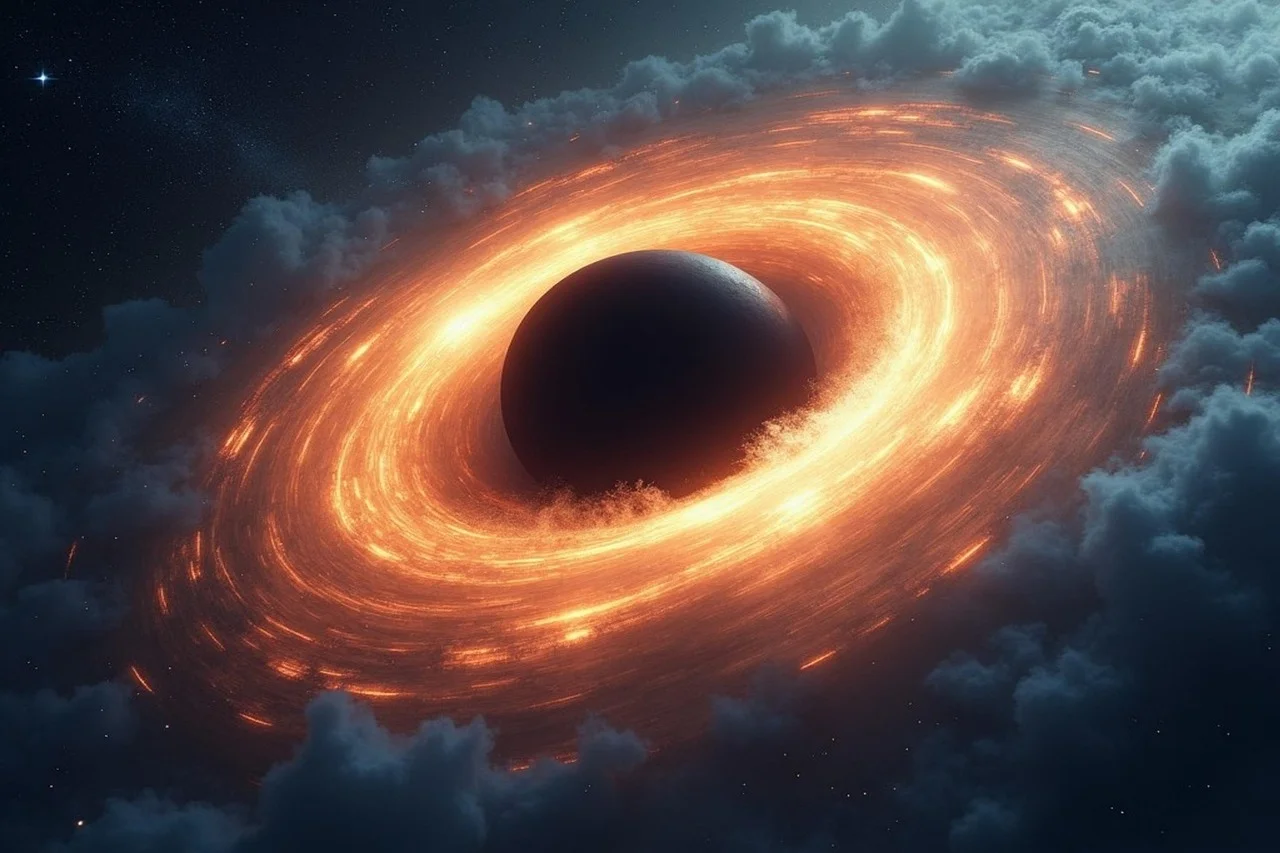
Another reason the sky is not filled with endless starlight is that stars are not distributed evenly across space, nor do they last forever. Stars form, evolve, and die, often leaving behind remnants like white dwarfs, neutron stars, or black holes that emit little to no visible light. The uneven distribution of stars means vast regions of empty space separate galaxies and clusters, further explaining why many lines of sight end in darkness rather than starlight.
Human perception of light and darkness
Our perception also plays a part. Human eyes are adapted to Earth’s conditions and cannot detect faint sources of light as effectively as telescopes. What seems like darkness to us is often revealed by astronomical instruments as filled with faint galaxies, nebulae, or distant quasars. In this sense, the darkness of the sky is partly an illusion created by the limits of human vision.
Scientific answers to Olbers’ paradox
Modern cosmology resolves Olbers’ Paradox by combining several explanations:
- The universe has a finite age – There hasn’t been enough time for light from all stars to reach us.
- The universe is expanding – Light is stretched into invisible wavelengths as it travels across space.
- Stars are finite and unevenly distributed – Many regions of the cosmos contain few or no luminous stars.
- Interstellar dust blocks some light – Material in space absorbs and scatters visible radiation.
Together, these factors explain why the night sky remains dark despite the abundance of stars scattered throughout the universe.
The philosophical dimension
Beyond physics, the darkness of the universe has philosophical implications. Ancient cultures often associated the night sky with mystery, the unknown, or the divine. In modern times, the dark sky symbolizes both the vast emptiness of space and the limits of human understanding. That the universe appears mostly dark, despite being full of energy and light at other wavelengths, is a reminder that human senses capture only a fraction of reality. Telescopes and satellites extend our vision, but the cosmic darkness continues to inspire awe and humility.
Darkness as a canvas for discovery
Paradoxically, the darkness of the universe has made discovery possible. If the sky were uniformly bright, it would be nearly impossible to distinguish individual stars, galaxies, or cosmic structures. The contrast between the dark sky and bright celestial objects allows astronomers to study the cosmos in detail, mapping galaxies, detecting exoplanets, and observing distant phenomena. In this way, the universe’s darkness is not merely a puzzle but also a gift, providing the backdrop against which scientific inquiry flourishes.
The night sky as a cosmic reminder
The question of why the universe is dark despite its abundance of stars leads us to insights about time, space, and human perception. The finite age of the universe, the expansion of space, and the limits of vision all contribute to the mystery. More than just an astronomical detail, the darkness of the night sky reflects the profound structure of the cosmos, reminding us that what we see is only a glimpse of a vast and evolving universe. For humanity, this darkness continues to be both a scientific puzzle and a source of wonder.