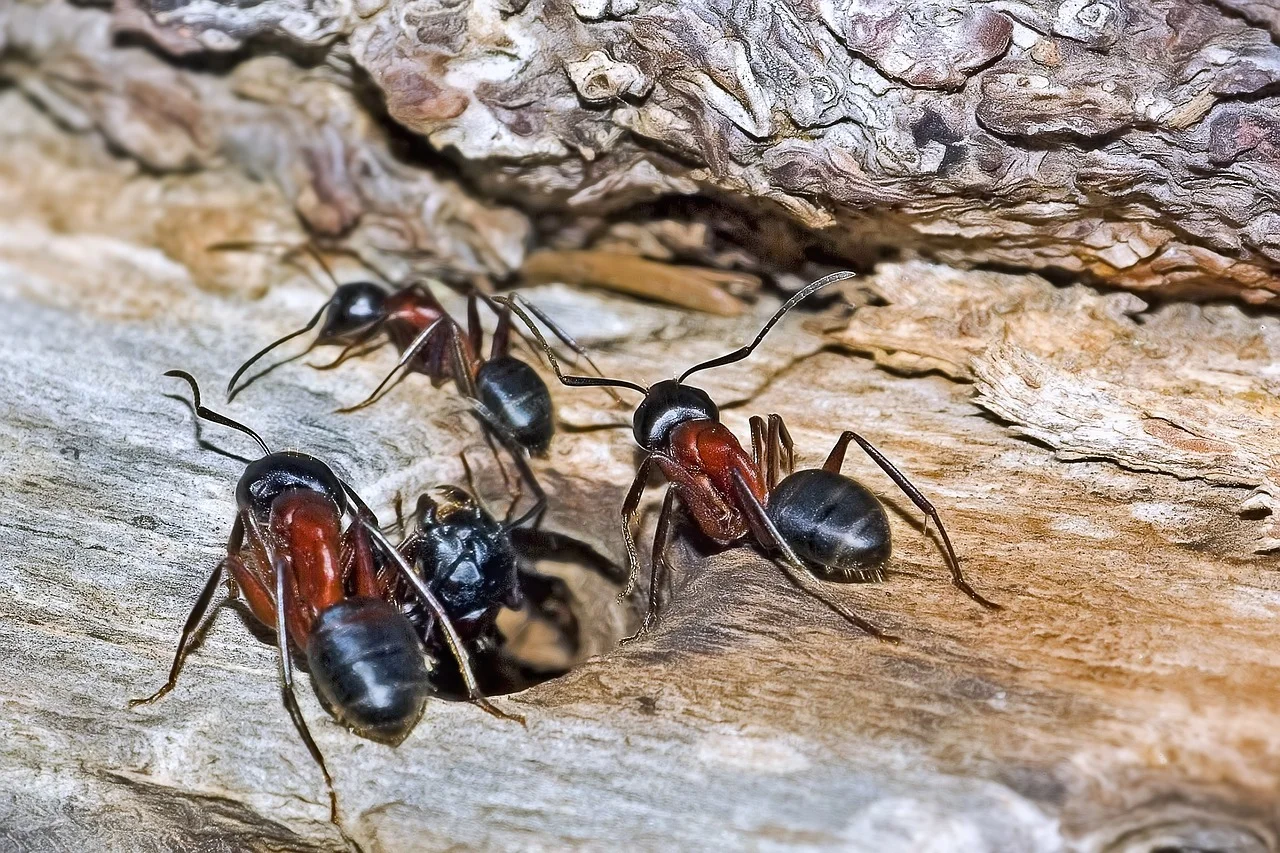
When people observe the organized bustle of an ant colony, it is tempting to assume that some kind of central leader directs the activity. Yet unlike human societies with rulers or commanders, ants operate without a single leader orchestrating their every move.
Despite this, their colonies build intricate nests, defend territories, cultivate food, and manage highly coordinated tasks that rival the efficiency of human-designed systems. The question of how ants achieve such remarkable complexity without leadership has fascinated scientists for decades.
The decentralized nature of ant societies
At first glance, the queen ant might appear to be the leader of a colony. However, her role is strictly reproductive—she lays eggs and ensures the colony’s continuation. She does not issue instructions to workers or direct the colony’s decisions. Instead, the functioning of an ant society arises from the combined behaviors of thousands, sometimes millions, of individual ants following simple rules. This decentralized system, where order emerges from local interactions rather than top-down command, is what allows ants to thrive in diverse environments.
Communication through pheromones
The primary tool ants use to coordinate their activities is chemical communication. Ants release pheromones, chemical signals that convey information to others in the colony. A worker that discovers food, for example, will leave a pheromone trail on its return journey, guiding nestmates to the source. The strength of the trail reflects how much food is available, as repeated trips reinforce the signal. Over time, weaker trails fade while stronger ones grow more pronounced, ensuring that the colony invests its energy where resources are abundant. This feedback loop creates efficient foraging patterns without centralized planning.
Stigmergy and self-organization
Scientists describe the process by which ants organize their work through the concept of stigmergy, where simple actions leave traces in the environment that influence the actions of others. For instance, when ants deposit soil while digging tunnels, their placement encourages other ants to build on the same structures, gradually producing intricate networks of chambers and passageways. No single ant designs the nest; instead, complex architecture arises from repeated local interactions. This principle of self-organization explains how colonies construct elaborate habitats with ventilation systems and specialized chambers for brood, food storage, and waste.
Division of labor through role specialization
Although ants lack a leader, they still exhibit division of labor. Different groups of ants take on roles such as foraging, brood care, nest maintenance, or defense. This specialization is not enforced by command but arises naturally from age, size, genetics, and environmental conditions. For example, younger ants often care for larvae inside the nest, while older ones venture outside to forage. Some species even produce morphologically distinct workers—such as soldiers with large jaws—adapted for specific tasks. The dynamic allocation of labor ensures that the colony can respond flexibly to changing circumstances.
Adaptive decision-making
One striking feature of ant colonies is their ability to make group decisions, such as choosing new nest sites. When forced to relocate, scout ants explore potential locations and return to recruit others using pheromones or physical signals. As more ants are drawn to favorable sites, recruitment accelerates until a threshold is reached, at which point the colony collectively commits to the chosen site. This process resembles a form of consensus building, achieved not through discussion but through amplification of local preferences. The result is a decision-making system that is both robust and adaptive.
Resilience through redundancy
The absence of a leader also makes ant societies highly resilient. Because no single individual holds critical decision-making power, the colony is not vulnerable to the loss of a leader. If some workers die, others can take over their roles, and pheromone-based communication ensures continuity. This redundancy allows colonies to recover quickly from setbacks, whether from predation, environmental changes, or human disturbance. In many ways, this distributed resilience mirrors modern human-designed networks, such as the internet, where decentralization protects against failure.
Learning from environmental feedback
Ant colonies do not rely solely on internal communication; they also adapt to cues from the environment. If food sources become depleted, pheromone trails fade and foraging shifts elsewhere. If a path is blocked, ants explore alternatives until new routes are established. This constant feedback ensures that the colony remains responsive to external conditions. Importantly, ants do not need to predict outcomes—they simply respond to local signals, and the colony as a whole benefits from the sum of these responses.
Parallels with human systems
The decentralized organization of ant colonies has inspired researchers in fields ranging from robotics to computer science. Algorithms for route optimization, such as those used in telecommunications and logistics, often draw inspiration from ant foraging behavior. Similarly, swarm robotics explores how simple agents can work collectively to solve complex tasks without central control. Ants demonstrate that cooperation does not require hierarchy, and their colonies serve as natural laboratories for studying distributed problem-solving.
Cultural fascination and symbolism
Beyond science, ants have long fascinated human culture as symbols of industriousness and cooperation. Ancient texts, from Aesop’s fables to biblical proverbs, celebrated their diligence. Yet the deeper lesson from modern research is that their success comes not from tireless obedience to a leader but from the capacity of individuals to interact and adapt collectively. This insight challenges traditional notions of organization, suggesting that cooperation and creativity can emerge even in the absence of command.
The hidden intelligence of collective behavior
The ability of ants to build vast colonies, cultivate fungus, wage wars, and sustain complex societies without leadership reveals the power of simple rules amplified through interaction. Their colonies embody self-organization, resilience, and adaptability, showing that intelligence can emerge not only in individual brains but also in collective systems. Ants teach us that order can arise from the bottom up, and that complexity does not always require central control. Their societies remind us that collaboration, when guided by shared signals and local responsiveness, can achieve extraordinary results.