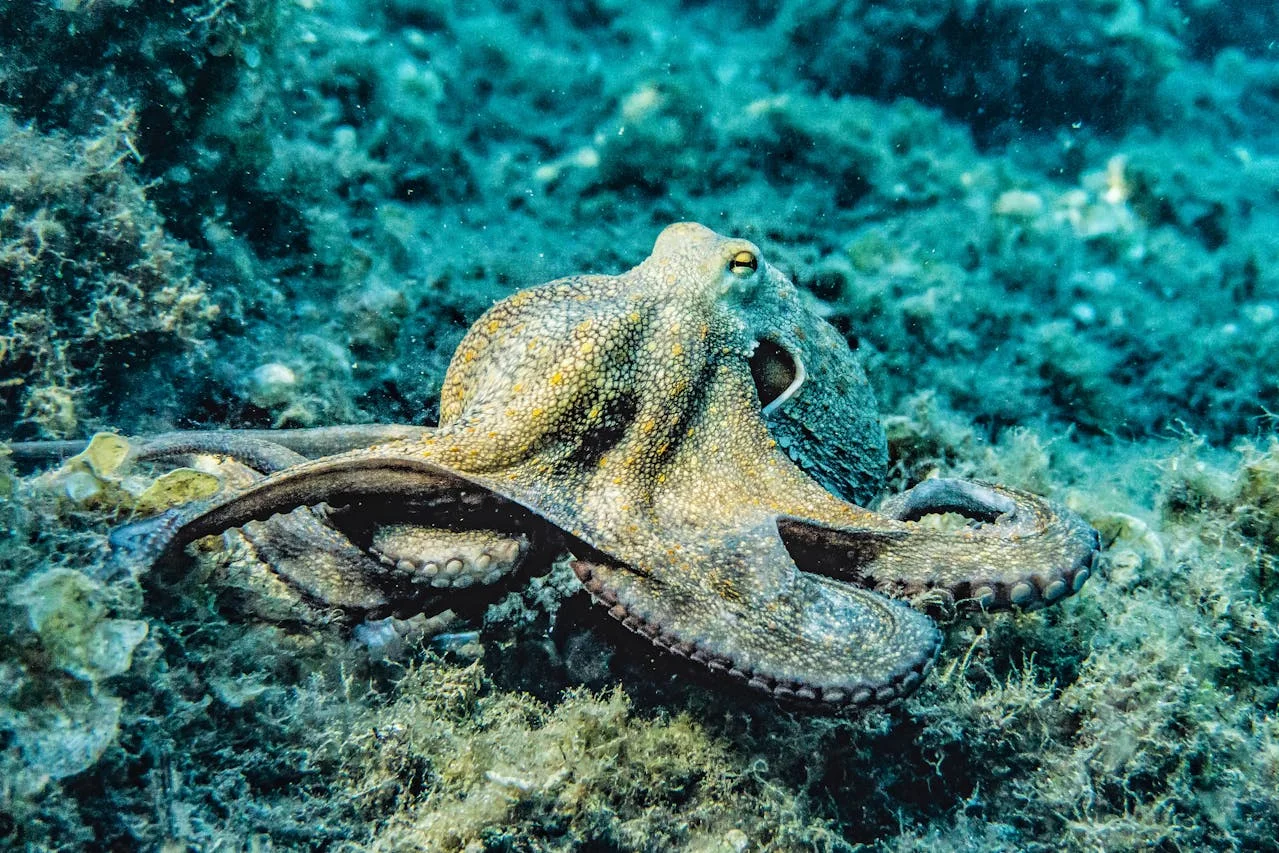
Among the many wonders of the ocean, few creatures capture human imagination like the octopus. These highly intelligent mollusks have evolved a camouflage system so advanced that they can change their appearance in less than a second.
To evade predators, sneak up on prey, or communicate with one another, octopuses alter not only their color but also their texture and body posture. This ability is the result of intricate biological systems working together with remarkable speed and precision. Understanding how octopuses camouflage themselves sheds light on one of the most extraordinary survival strategies in the natural world.
Chromatophores: the foundation of color change
At the heart of octopus camouflage are specialized skin cells called chromatophores. Each chromatophore contains a tiny sac filled with pigment, surrounded by radial muscles. When the muscles contract, the pigment sac expands like an opening umbrella, spreading color across the skin. When the muscles relax, the sac shrinks, and the color disappears. Millions of chromatophores containing yellow, red, brown, or black pigments cover the octopus’s body. By controlling them with fine precision, octopuses can produce patterns ranging from uniform shading to intricate mottling that perfectly blends with their environment.
Iridophores and leucophores: adding shimmer and depth
While chromatophores create the base colors, two other types of skin cells—iridophores and leucophores—contribute to the octopus’s sophisticated camouflage. Iridophores are reflective cells that manipulate light through structural interference, producing shimmering blues, greens, and silvers. These cells mimic the way sunlight scatters on the ocean floor or bounces off fish scales. Leucophores, on the other hand, scatter incoming light and act as “white canvases” that reflect the surrounding environment’s dominant colors. Together, these cells enable octopuses to create optical illusions that extend far beyond pigment alone.
The role of the nervous system
What makes octopus camouflage truly remarkable is not just the diversity of skin cells but the speed with which they are controlled. Octopuses have a highly developed nervous system, with large portions of their neurons distributed throughout their arms. This decentralized structure allows local control of skin cells, enabling rapid, precise adjustments. Visual information from the octopus’s eyes travels to its brain and then to motor neurons connected to chromatophores, iridophores, and leucophores. Within milliseconds, the animal’s appearance shifts, allowing it to adapt nearly instantaneously to its environment.
Texture transformation with papillae
Camouflage for octopuses is not only about color; it also involves altering skin texture. Specialized muscles called papillae allow the skin to raise into bumps, ridges, or spiky projections. This ability lets octopuses imitate the roughness of coral, the smoothness of sand, or the jagged edges of rocks. By combining color changes with texture transformation, octopuses achieve three-dimensional mimicry, making them nearly indistinguishable from their surroundings. A flat patch of skin can become pebbled like gravel in an instant, further enhancing disguise.
Vision and environmental awareness
For camouflage to work, octopuses must accurately interpret their surroundings. They have highly developed eyes that detect contrast and polarization rather than a full spectrum of colors, which may seem surprising. Yet this is sufficient to analyze patterns of light and shadow in their environment. Researchers believe octopuses use these visual cues, along with skin-based light sensors, to decide which camouflage pattern to deploy. Despite their limited color vision, octopuses excel at reproducing the essential textures and contrasts of their habitat.
Three primary camouflage strategies
Octopuses rely on three major camouflage modes:
- Uniform camouflage – The skin adopts a single, consistent color to match a sandy or monotone background.
- Mottled camouflage – Small patches of contrasting colors break up the outline, ideal for blending with gravel or mixed seafloor textures.
- Disruptive camouflage – Bold patterns of contrasting patches obscure the octopus’s body shape, making it harder for predators to recognize it as prey.
By switching between these modes in fractions of a second, octopuses adapt to changing surroundings with astonishing fluidity.
Predator evasion and survival
Camouflage is a critical survival tool for octopuses, which lack protective shells like their mollusk relatives. Their soft bodies make them vulnerable to fish, sharks, eels, and even seabirds. By blending seamlessly into their habitat, octopuses can avoid detection altogether. If discovered, they often combine camouflage with other defenses, such as inking or jetting away. The ability to disappear in plain sight reduces the need for constant flight, conserving energy and increasing survival chances in predator-rich environments.
Hunting advantages of disguise
Camouflage is not only defensive—it also aids in hunting. Octopuses are ambush predators, feeding on crabs, fish, and mollusks. By blending into rocks or coral, they can lie in wait until prey approaches. In some cases, octopuses even mimic objects like algae-covered stones, allowing them to inch closer without alarming their target. When the moment is right, they strike with speed, extending their arms and using suction cups to capture prey. Camouflage thus plays a dual role in both protection and predation.
Learning and adaptive behavior
Octopuses are known for their intelligence, and their camouflage system reflects behavioral flexibility. They do not rely solely on instinct but also adapt through learning. Experiments have shown that octopuses can modify their camouflage in unfamiliar environments, suggesting a capacity to generalize patterns and test different strategies. This adaptability ensures survival in diverse habitats, from shallow reefs to deep-sea regions, and contributes to their reputation as masters of disguise.
Inspiration for human technology
Scientists studying octopus camouflage are also inspired to create new technologies. Research into chromatophores and iridophores has influenced the development of adaptive materials, such as color-changing fabrics, dynamic camouflage for military use, and responsive display technologies. The octopus demonstrates a natural system of instant pattern generation that engineers hope to replicate in artificial settings. By understanding how octopuses achieve their split-second transformations, humans may one day design technologies that mimic their extraordinary adaptability.
Camouflage as a window into evolution’s creativity
The octopus’s camouflage abilities illustrate the ingenuity of evolution. Through millions of years of adaptation, these animals developed one of the most complex skin systems in nature, combining color, texture, and behavior into a seamless survival strategy. Their rapid transformations are not just biological tricks but reflections of a deep evolutionary dialogue between predator and prey, visibility and concealment, vulnerability and resilience. By studying octopuses, we not only marvel at their abilities but also gain insight into the dynamic pressures that shape life beneath the waves.