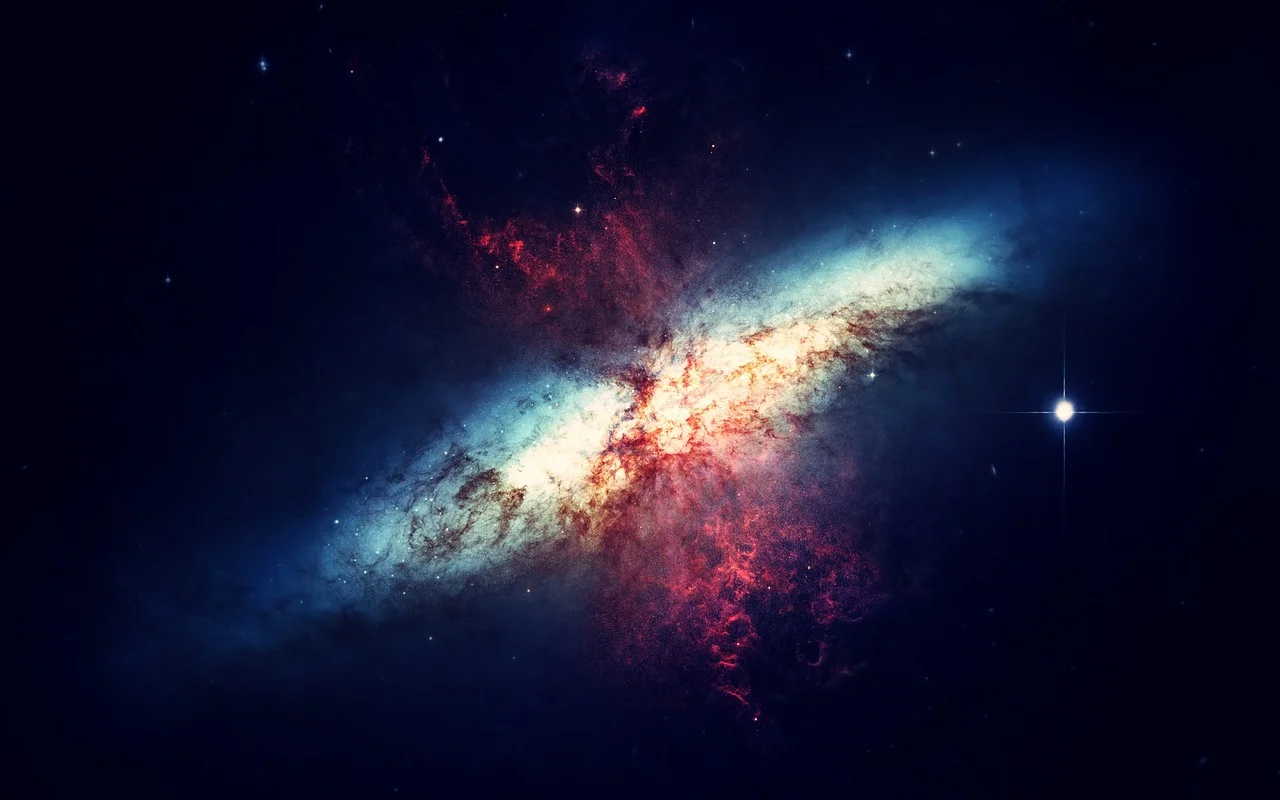
The birth of galaxies is one of the most profound mysteries in cosmology. Galaxies are sprawling systems of stars, gas, dust, and dark matter, yet they began as small fluctuations in the early universe after the Big Bang. Observing this process directly is impossible—galaxies form over billions of years.
To overcome this challenge, scientists turn to simulations, using advanced physics and supercomputers to recreate how galaxies emerge and evolve. These models allow researchers to peer into cosmic history, testing theories and uncovering insights into the forces that shaped the universe.
The challenge of studying galaxy formation
Galaxies are extraordinarily complex. They contain hundreds of billions of stars, interact with dark matter, and evolve under the influence of gravity, radiation, and magnetic fields. Capturing this process in detail requires integrating a vast range of physical phenomena, from the behavior of tiny hydrogen atoms to the dynamics of clusters of galaxies. Simulations bridge this gap, offering a virtual laboratory where scientists can experiment with different conditions to see how galaxies might form.
The role of cosmological principles
Simulations begin with the initial conditions of the universe as described by cosmology. Tiny density fluctuations in the early cosmos, mapped by the cosmic microwave background radiation, serve as seeds for galaxy formation. By applying the laws of physics—particularly gravity, thermodynamics, and hydrodynamics—scientists can track how these initial irregularities grew into the massive structures we see today. Without these cosmological foundations, simulations would lack the framework to explain the universe’s large-scale structure.
Supercomputers and their power
Simulating galaxy formation requires immense computational resources. Supercomputers can perform trillions of calculations per second, enabling models that include millions or even billions of particles. Each particle may represent a star, a cloud of gas, or a unit of dark matter. The complexity of these simulations grows as researchers aim for higher resolution, seeking to capture fine details of how gas clouds collapse or how stellar winds shape galaxies. Without these powerful machines, galaxy formation models would remain simplistic and incomplete.
Dark matter as a foundation
Dark matter, an invisible substance making up about 85% of the universe’s matter, plays a critical role in galaxy formation simulations. In models, dark matter clumps together under gravity, creating halos that act as scaffolding for galaxies. Gas then falls into these halos, cooling and condensing to form stars. By adjusting the properties of dark matter in simulations, scientists can test how its distribution influences the size, shape, and behavior of galaxies. This provides clues about the mysterious substance that cannot be observed directly.
Modeling gas and star formation
Gas dynamics are central to galaxy simulations. Hydrogen and helium gas, the building blocks of stars, flow into dark matter halos. To simulate this, scientists use hydrodynamic equations that describe how fluids move and interact. When gas cools sufficiently, it collapses under gravity to ignite star formation. Models must also account for the feedback from stars—supernovae explosions, stellar winds, and radiation—that heat surrounding gas and regulate future star births. This self-regulating cycle is essential for reproducing galaxies that resemble real ones.
The role of feedback processes
Without feedback, simulations would produce galaxies far too dense and bright compared to those we observe. Feedback from stars and supermassive black holes injects energy into surrounding gas, preventing it from collapsing too quickly. For example, jets from black holes can push gas out of galaxies, slowing star formation. By incorporating these feedback mechanisms, simulations achieve more realistic results. These processes demonstrate how even small-scale phenomena, like a single exploding star, influence cosmic structures on vast scales.
Large-scale simulations of the universe
Some of the most famous galaxy simulations are large-scale projects that model vast portions of the universe. Examples include the Millennium Simulation, Illustris, and EAGLE. These projects track billions of particles over cosmic time, reproducing not just individual galaxies but entire clusters and cosmic filaments. By comparing these virtual universes with actual astronomical surveys, scientists test whether their models align with reality. Such simulations reveal how galaxies form, merge, and cluster together in ways that match observations.
Zooming in on galaxy details
In addition to large-scale models, researchers create “zoom-in” simulations focusing on a single galaxy or a small region. These high-resolution models can capture fine details such as spiral arms, star-forming regions, and the effects of magnetic fields. By studying specific features, scientists can better understand the processes that shape different types of galaxies, from spirals like the Milky Way to giant ellipticals. These simulations highlight the balance between cosmic-scale forces and local physics in determining galaxy structure.
Comparing simulations with observations
To validate simulations, scientists compare their outcomes with real astronomical data. Observatories such as the Hubble Space Telescope and the James Webb Space Telescope provide deep images of galaxies across different epochs. Surveys of galaxy distribution and motion also serve as benchmarks. When simulations successfully reproduce observed phenomena—such as the rate of star formation or the distribution of galaxies—they gain credibility. Discrepancies, however, highlight areas where models must improve, leading to refinements in our understanding of physics.
Limitations and ongoing challenges
Despite their sophistication, galaxy simulations face limitations. Some processes, such as turbulence in gas clouds or the behavior of magnetic fields, are too complex to model fully. Instead, scientists use approximations, known as “subgrid physics,” to represent phenomena that occur on scales smaller than the simulation can capture. Balancing computational feasibility with accuracy remains a constant challenge. As technology advances, researchers aim to reduce these limitations, moving closer to simulations that mirror reality with even greater precision.
Galaxies in the laboratory of the mind
Simulating the birth of galaxies is not only a technical achievement but also a conceptual triumph. By combining cosmology, physics, and cutting-edge computing, scientists create virtual universes that mirror our own. These simulations reveal the delicate interplay of matter, energy, and time, offering glimpses into processes that span billions of years. More than digital experiments, they are tools that expand human imagination, helping us understand the origins of the structures that define the cosmos. In this way, simulations transform galaxies from distant mysteries into accessible stories written in the language of science.