Beyond the orbit of Neptune and the known reaches of the Kuiper Belt lies one of the most enigmatic and least understood regions of our solar system — the Oort Cloud. Named after Dutch astronomer Jan Oort, this distant spherical shell of icy bodies represents the farthest boundary of the Sun’s gravitational influence.
Though no spacecraft has ever visited it and no object within it has been observed directly, the Oort Cloud remains one of the most intriguing frontiers in planetary science and astronomy. It is believed to be the origin point of many long-period comets and possibly holds clues about the earliest days of our solar system’s formation.
What Is the Oort Cloud?
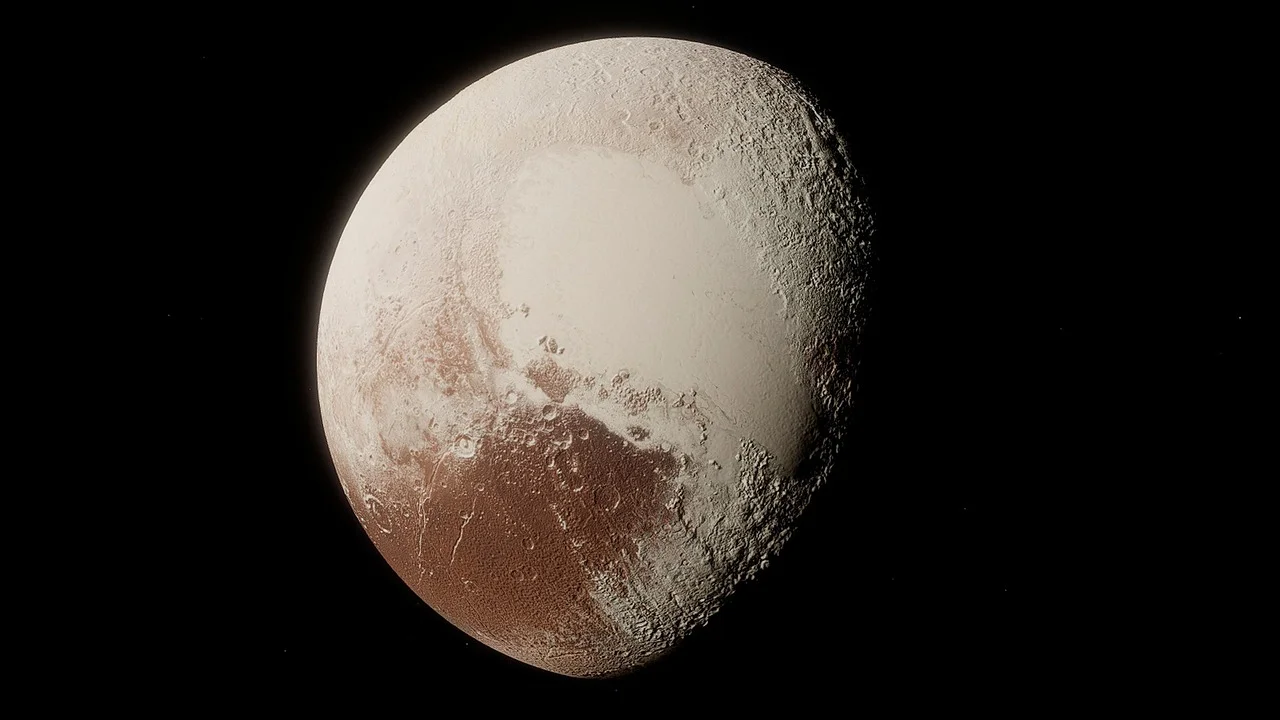
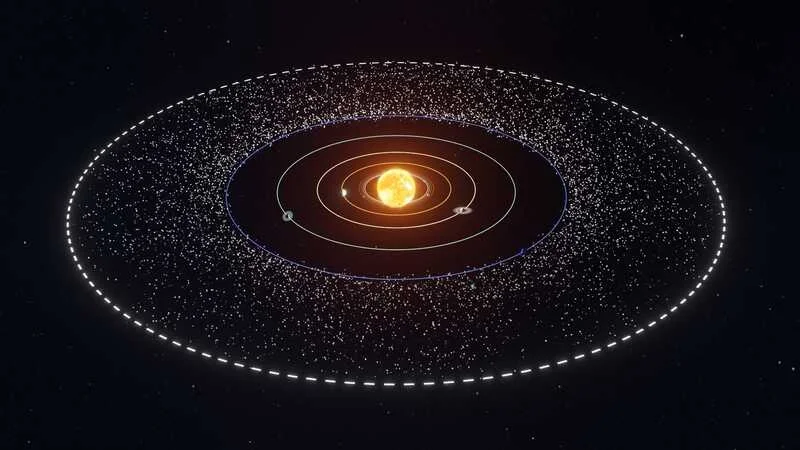
The Oort Cloud is a theoretical region located at the very edge of the solar system. It is believed to contain billions, possibly trillions, of icy bodies and comet-like objects that orbit the Sun in a vast, spherical distribution. While the Kuiper Belt — which includes objects like Pluto — extends from about 30 to 50 astronomical units (AU) from the Sun, the Oort Cloud is much farther away, starting at around 2,000 AU and possibly stretching up to 100,000 AU. For context, 1 AU is the average distance from the Earth to the Sun, approximately 93 million miles (150 million kilometers).
Unlike the disk-shaped Kuiper Belt, the Oort Cloud is thought to be a spherical shell surrounding the entire solar system. This three-dimensional structure means it surrounds the Sun, planets, and the Kuiper Belt from all directions, forming a sort of icy halo.
The Origin of the Oort Cloud
Though still theoretical, the Oort Cloud’s existence is supported by indirect evidence — primarily the behavior of long-period comets. These comets, which can take thousands or even millions of years to complete one orbit around the Sun, often approach from random angles and directions, suggesting a distant, spherical source region.
Scientists believe the Oort Cloud formed early in the history of the solar system. During the formation of the gas giants, especially Jupiter and Saturn, the gravitational influence of these massive planets likely ejected many icy planetesimals from the inner solar system into distant, elongated orbits. Some of these objects may have settled into the stable region of the Oort Cloud, held in place by the Sun’s weak but still present gravitational pull.
Structure of the Oort Cloud
The Oort Cloud is generally divided into two parts:
- Inner Oort Cloud (or Hills Cloud): This is a somewhat disk-like region ranging from approximately 2,000 to 20,000 AU. It is believed to be more densely populated than the outer portion.
- Outer Oort Cloud: This more spherical region could extend from 20,000 AU all the way up to 100,000 AU. The outer Oort Cloud is where many long-period comets are thought to originate.
Because of its extreme distance and the small size of its components, the Oort Cloud is incredibly difficult to detect or study directly. All current models of the Oort Cloud are based on mathematical predictions and the analysis of cometary orbits.
Comets: Messengers from the Edge
One of the most compelling pieces of indirect evidence for the Oort Cloud is the existence of long-period comets, such as Comet Hale-Bopp and Comet ISON. These comets have orbits that are highly eccentric and inclined at random angles, consistent with an origin far beyond the plane of the solar system.
Comets from the Oort Cloud are often disturbed from their stable orbits by gravitational nudges from passing stars, molecular clouds, or even the tidal forces of the Milky Way galaxy. Once dislodged, they fall inward toward the Sun, giving us a rare glimpse into the distant and ancient materials that have remained largely unchanged for billions of years.
Scientific Significance of the Oort Cloud
Studying the Oort Cloud — even indirectly — is incredibly valuable for several reasons:
- Pristine Material: Objects in the Oort Cloud are thought to be composed of the original ices and dust from the solar nebula. This makes them time capsules of the early solar system.
- Comet Origins: Understanding the Oort Cloud can help explain the origin, evolution, and frequency of comets that pass through the inner solar system.
- Solar System Boundaries: The Oort Cloud marks the outermost limits of the Sun’s gravitational domain — a key parameter in understanding how far the Sun’s influence extends.
- Planetary Formation Clues: The distribution and dynamics of Oort Cloud objects can shed light on the migration and development of the giant planets during the solar system’s youth.
Challenges in Studying the Oort Cloud
The Oort Cloud’s vast distance and lack of direct observation make it one of the most elusive targets in astronomy. Even the most powerful telescopes cannot resolve its objects, and spacecraft would take thousands of years to reach it using current propulsion technology.
Additionally, the small size and faint albedo of Oort Cloud bodies mean they do not reflect enough sunlight to be seen easily. Many of them are likely just a few kilometers in diameter — far too small and dim to detect with even our best instruments.
Could We Ever Visit the Oort Cloud?
While a mission to the Oort Cloud remains firmly in the realm of science fiction for now, it’s not impossible in the distant future. Proposed technologies like nuclear propulsion or solar sails might one day allow humanity to send probes to the outer reaches of the solar system. Such a mission would be a monumental step in our understanding of the solar system’s boundaries, but it would also require major advances in propulsion, power systems, and data transmission over vast distances.
Popular Culture and the Oort Cloud
The Oort Cloud has captured the imagination of science fiction writers and space enthusiasts alike. Its vast, mysterious nature and potential as a comet nursery make it a frequent setting in speculative stories about alien life, space exploration, or threats from outer space. While these portrayals often take artistic liberties, they underscore how deeply the concept of the Oort Cloud resonates with our sense of cosmic wonder.
The Oort Cloud remains one of the most fascinating and least explored regions of our solar system. Though invisible and largely theoretical, its existence is a crucial piece of the puzzle in understanding our cosmic neighborhood. From serving as the source of long-period comets to marking the final frontier of the Sun’s gravitational reach, the Oort Cloud represents the boundary between the known and the unknown. As our technology advances and our ambitions grow bolder, the secrets of this icy halo may one day be revealed — shedding light on not only where we come from, but where we might go next.