The Taiping Rebellion, which lasted from 1850 to 1864, ranks among the most devastating conflicts ever recorded. Centered in China during the Qing dynasty, the uprising caused the deaths of an estimated 20 to 30 million people, possibly more.
Unlike many wars defined by foreign invasions or ideological movements with international backing, the Taiping Rebellion was rooted in internal grievances, religious visions, and regional instability. Its scale, duration, and brutality made it more than a civil war—it became a demographic and political catastrophe.
Origins in religious ideology
At the heart of the Taiping Rebellion was a man named Hong Xiuquan, a failed civil service candidate who claimed to have visions after falling ill. He believed he was the younger brother of Jesus Christ and had been chosen to rid China of demons—interpreted as the ruling Manchu elite.
Hong’s spiritual awakening led him to form the God Worshipping Society, a group that blended elements of Christianity with anti-Qing sentiment. His teachings rejected traditional Confucian values and local religious practices, promoting a new social order rooted in moral purity, gender equality, and the destruction of idols and temples.
Systemic collapse and local discontent
Multiple layers of discontent fueled the rebellion. China in the mid-19th century was facing serious internal and external pressures. The Opium Wars had weakened the Qing dynasty and drained financial resources. Population growth outpaced food production, leading to famine and widespread poverty. Corruption among local officials and tax collectors further eroded public trust.
For millions of Chinese peasants, life had become nearly unlivable. The promise of a new, more just society attracted large numbers of followers to the Taiping movement. Its message resonated especially with the Hakka people—an ethnic subgroup often marginalized and displaced by social unrest and natural disasters.
Military organization and rapid expansion
The Taiping movement quickly transitioned from a religious sect into a structured military force. By 1851, it declared the establishment of the Taiping Heavenly Kingdom, with Hong Xiuquan as its Heavenly King. A hierarchy of kings managed different functions of governance and warfare, creating a pseudo-state that operated independently from Qing authority.
Taiping forces moved with surprising speed and effectiveness. They captured key cities including Nanjing, which they renamed Tianjing („Heavenly Capital”), and used as their capital for over a decade. At its height, the rebellion controlled vast regions of southern China and had a military force numbering in the hundreds of thousands.
Factors that contributed to the massive death toll
Several key dynamics explain why the Taiping Rebellion resulted in such a staggering number of casualties:
- Prolonged fighting – The conflict lasted 14 years, with continuous battles, sieges, and ambushes across densely populated areas.
- Widespread famine – Agricultural disruption caused by scorched-earth tactics and mass conscription left many regions without food.
- Civilian targeting – Both Taiping and Qing forces committed atrocities, targeting villages, perceived collaborators, and ethnic groups.
- Disease outbreaks – Displacement, poor sanitation, and lack of medical infrastructure led to deadly epidemics among soldiers and civilians.
The destruction of irrigation systems, abandonment of farmland, and constant movement of troops decimated the rural economy. Many civilians died not directly from combat but from starvation and exposure.
Brutality on both sides
Combat during the rebellion was marked by extreme violence. The Taiping leadership enforced harsh discipline within their ranks, executing deserters and dissenters. Religious fanaticism intensified their aggression, particularly against Confucian scholars and Buddhist or Taoist temples.
The Qing government, in response, deployed not only regular troops but also regional militias and warlords. Some of the worst atrocities were committed by these semi-independent forces, which operated with little oversight. The reconquest of cities often involved mass executions and purges.
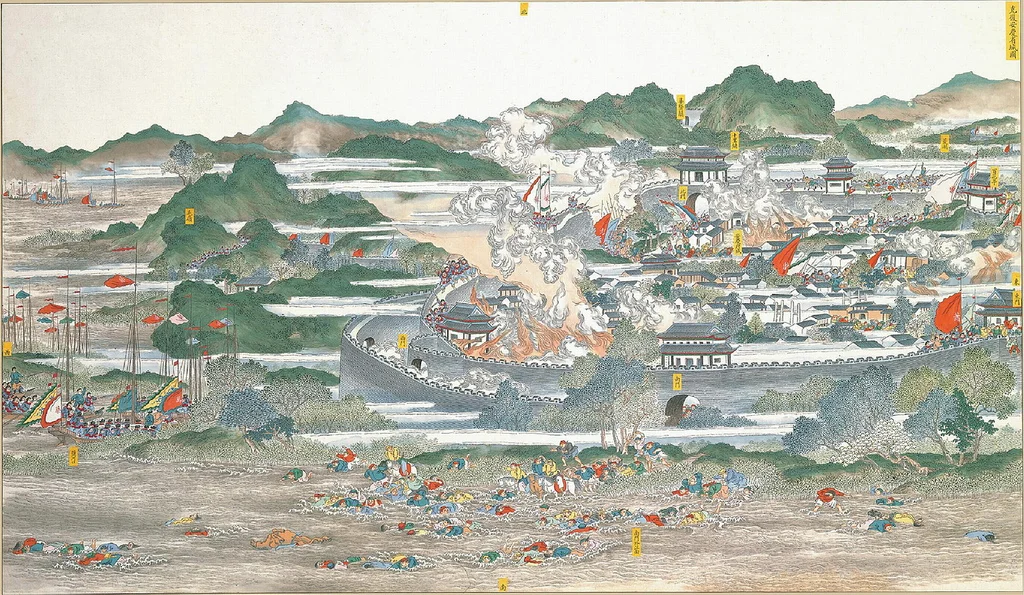
Notably, the recapture of Nanjing in 1864 ended with the slaughter of hundreds of thousands of Taiping followers. The devastation was not limited to the battlefield—it extended to cities, countryside, and entire communities wiped out in retaliation or panic.
Foreign involvement and indirect impact
While the Taiping Rebellion was largely a domestic conflict, it drew attention from Western powers active in China at the time. Missionaries initially viewed the Taipings favorably due to their use of Christian imagery and rejection of traditional Chinese religions. However, upon closer contact, most realized the Taiping version of Christianity diverged significantly from orthodox doctrine.
Western nations, particularly Britain and France, ultimately supported the Qing government, largely to protect their commercial interests. Foreign-trained forces, such as the Ever Victorious Army led by American and European officers, helped the Qing recapture key cities.
Although foreign troops were limited in number, their strategic support, along with advanced weaponry and naval power, helped tip the balance. This intervention also highlighted the growing entanglement of global powers in China’s internal affairs.
Destruction of infrastructure and cultural loss
Entire provinces were left in ruins. Canals, bridges, and city walls were destroyed. Farming tools and livestock were seized or lost. With so much agricultural land abandoned, China faced several years of poor harvests even after the fighting ended.
Cultural landmarks, libraries, and religious sites were also casualties. Taiping doctrine opposed traditional Chinese customs and institutions. Temples, ancestral halls, and Confucian academies were systematically burned or looted in Taiping-controlled areas. In response, Qing forces carried out their own wave of cultural destruction during reconquest campaigns.
Impact on population and society
The human toll of the Taiping Rebellion is often compared to that of World War I or even World War II. In addition to the millions killed directly or indirectly, entire communities were displaced. Some regions lost over half their population, leading to long-term demographic imbalances.
The trauma of the rebellion left deep scars. Family structures collapsed, landownership patterns changed, and the social order was permanently altered. Many survivors had to flee, resettle, or reinvent their livelihoods in the aftermath of prolonged conflict.
The following table summarizes some comparisons to other major conflicts:
| Conflict | Estimated Death Toll |
|---|---|
| Taiping Rebellion | 20–30 million |
| World War I | 15–20 million |
| World War II (China) | 20 million (China alone) |
| Napoleonic Wars | 3–6 million |
Political consequences for the Qing dynasty
Though the Qing regime survived the rebellion, it was permanently weakened. The dynasty relied heavily on regional warlords and local militias, reducing centralized control. In many cases, powerful provincial leaders retained their autonomy after the war, setting the stage for further instability in the decades that followed.
Additionally, the cost of suppressing the rebellion—both financially and militarily—drained the empire’s resources. Efforts to modernize China in the aftermath were hampered by internal distrust, fragmented authority, and continuing resistance.
Legacy of the Taiping Rebellion
The Taiping Rebellion reshaped China’s internal landscape and became a symbol of both revolutionary potential and national trauma. Later reformers and revolutionaries studied the uprising closely, seeing it as a precursor to movements that sought to transform China from within.
It also changed how future conflicts were fought in China, blending ideology, religion, and regional identity into powerful forces. Despite its religious beginnings, the rebellion became a devastating example of how internal fragmentation and social unrest can evolve into mass-scale conflict with far-reaching consequences.