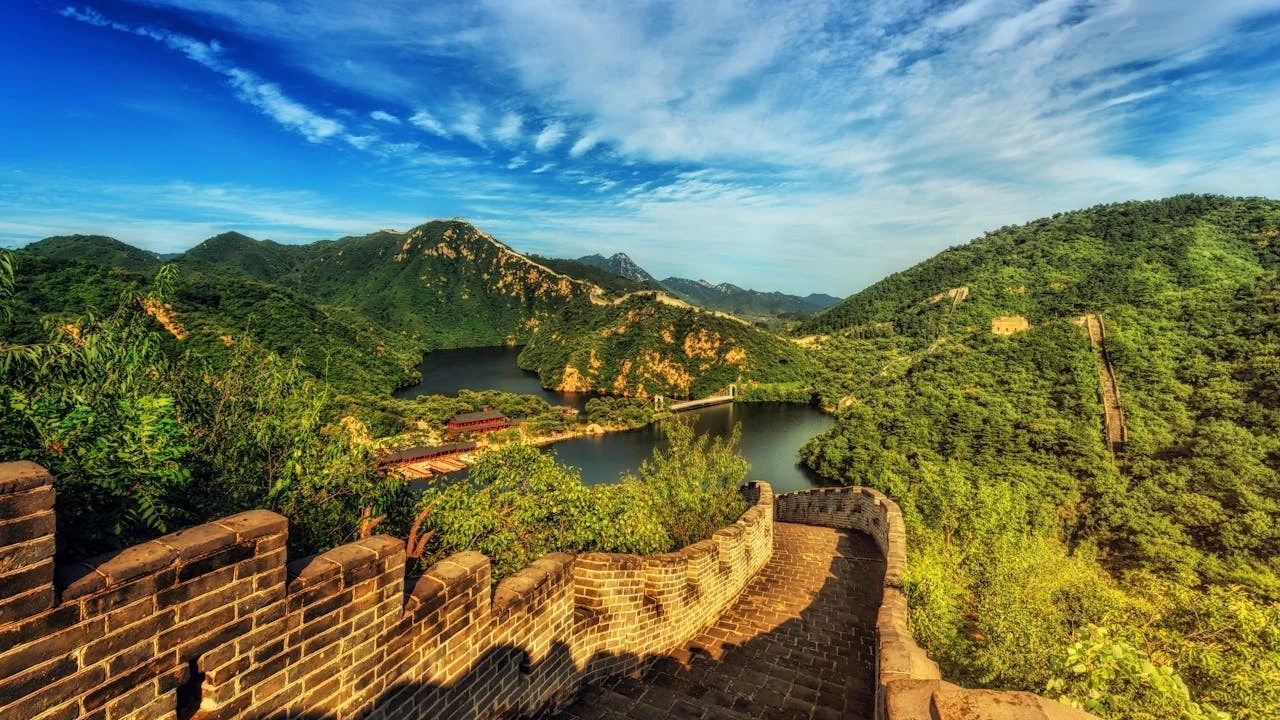
The Great Wall of China stands as one of history’s most iconic feats of engineering, stretching thousands of kilometers across mountains, deserts, and plains. While often imagined as a single continuous structure, the Wall was not the product of one era or ruler.
Instead, it was built in stages over more than two millennia, shaped by shifting political priorities, military needs, and cultural visions of security.
Early defensive walls before unification
Long before the Great Wall as we know it, Chinese states constructed walls to defend their territories. During the Spring and Autumn (770–476 BCE) and Warring States (475–221 BCE) periods, rival kingdoms built fortifications to protect against both neighboring states and nomadic groups from the north. These early walls were primarily made of tamped earth and served as practical but temporary barriers. Each wall was local in scale, designed not to unify China but to protect fragmented states in a time of constant warfare.
The Qin Dynasty and the first unification
In 221 BCE, Qin Shi Huang unified China and became its first emperor. He recognized the need to protect his empire’s northern frontier from incursions by nomadic groups such as the Xiongnu. Instead of building an entirely new wall, he ordered the linking of existing regional walls, creating the first version of a unified Great Wall. These efforts symbolized not just military defense but also political consolidation, as they merged the protective strategies of different states into a single imperial system. However, the Qin construction was relatively crude and eroded quickly over time.
The Han Dynasty’s expansion and reinforcement
The Han Dynasty (206 BCE–220 CE) expanded the Wall significantly to protect growing trade networks, especially the Silk Road. As commerce flourished, the Wall was extended deep into western regions to secure caravans and ensure safe passage through vulnerable areas. The Han rulers also introduced watchtowers, garrisons, and signaling systems that transformed the Wall from a simple barrier into a complex frontier defense network. This stage reflected the Wall’s evolving purpose: it was not only about keeping enemies out but also about protecting economic lifelines that connected China to Central Asia and beyond.
Periods of decline and rebuilding
After the fall of the Han Dynasty, China experienced centuries of fragmentation and shifting power. During these times, the Wall was often neglected, left to crumble without maintenance. Some dynasties, such as the Sui and Tang, prioritized offensive campaigns against nomadic groups instead of investing heavily in defensive walls. Yet whenever external pressures grew, rulers returned to fortifications, rebuilding and expanding sections of the Wall. This cyclical pattern of neglect and reconstruction illustrates how the Wall’s importance waxed and waned depending on the political and military climate of the time.
The Ming Dynasty’s monumental construction
The most famous and enduring sections of the Wall were built under the Ming Dynasty (1368–1644). Facing repeated invasions from the Mongols, the Ming rulers undertook a massive reconstruction effort. They replaced earlier earthen walls with stone and brick, creating fortifications strong enough to endure centuries. The Ming Wall included fortified passes, beacon towers, and elaborate battlements, transforming the Wall into the monumental structure often associated with China today. This stage reflected both practical defense needs and the dynasty’s desire to demonstrate its strength and permanence.
Why the Wall was built in stages
Several factors explain why the Great Wall was built over centuries rather than as a single unified project:
- Changing threats – Different dynasties faced different enemies, from the Xiongnu in the Qin period to the Mongols in the Ming. Each required new strategies and fortifications.
- Shifting priorities – Some rulers prioritized offensive campaigns or diplomacy, while others emphasized defensive walls. This meant that investment in the Wall rose and fell over time.
- Vast geography – The northern frontier stretched across deserts, mountains, and grasslands, making a single unified wall nearly impossible to construct in one era.
- Technological evolution – Building techniques improved over centuries, shifting from tamped earth to durable stone and brick.
The Wall’s incremental growth reflects China’s long history of adaptation to its environment and challenges.
Symbolic meaning across dynasties
Beyond its military role, the Wall acquired symbolic importance. For the Qin, it was a testament to unification; for the Han, it represented the safeguarding of commerce; and for the Ming, it embodied resilience against powerful enemies. Each dynasty left its mark on the Wall, turning it into a living monument of shifting identities and ambitions. This layered construction explains why the Great Wall is not uniform but rather a patchwork of styles and materials, reflecting the cultural and political diversity of the dynasties that built it.
Economic and human costs
Building the Wall over centuries required immense human and material resources. Hundreds of thousands of laborers, including soldiers, peasants, and prisoners, were conscripted for construction. Harsh working conditions led to many deaths, and legends suggest the Wall became a “long graveyard” for those who perished during its building. Despite the human toll, rulers viewed the Wall as essential for protecting the empire’s survival and prosperity. Its construction was a testament to the lengths rulers would go to secure their realms.
The Wall’s legacy in modern times
Today, the Great Wall is recognized not only as a historical monument but also as a symbol of China’s endurance and ingenuity. Its construction in stages over centuries highlights the adaptability of Chinese civilization to shifting threats and opportunities. While no longer a military defense system, the Wall remains a powerful cultural icon, attracting millions of visitors each year and serving as a reminder of the country’s long and complex history.
A monument of persistence
The Great Wall of China was built in stages over centuries because China’s history itself unfolded in stages. Each dynasty, facing different challenges, added its own contribution, shaping the Wall into a vast and multifaceted structure. It stands today not as the work of one ruler or era but as a monument to persistence, adaptation, and the enduring human desire for security. In its stones and earthworks, the Wall tells the story of a civilization that evolved, survived, and redefined itself over millennia.