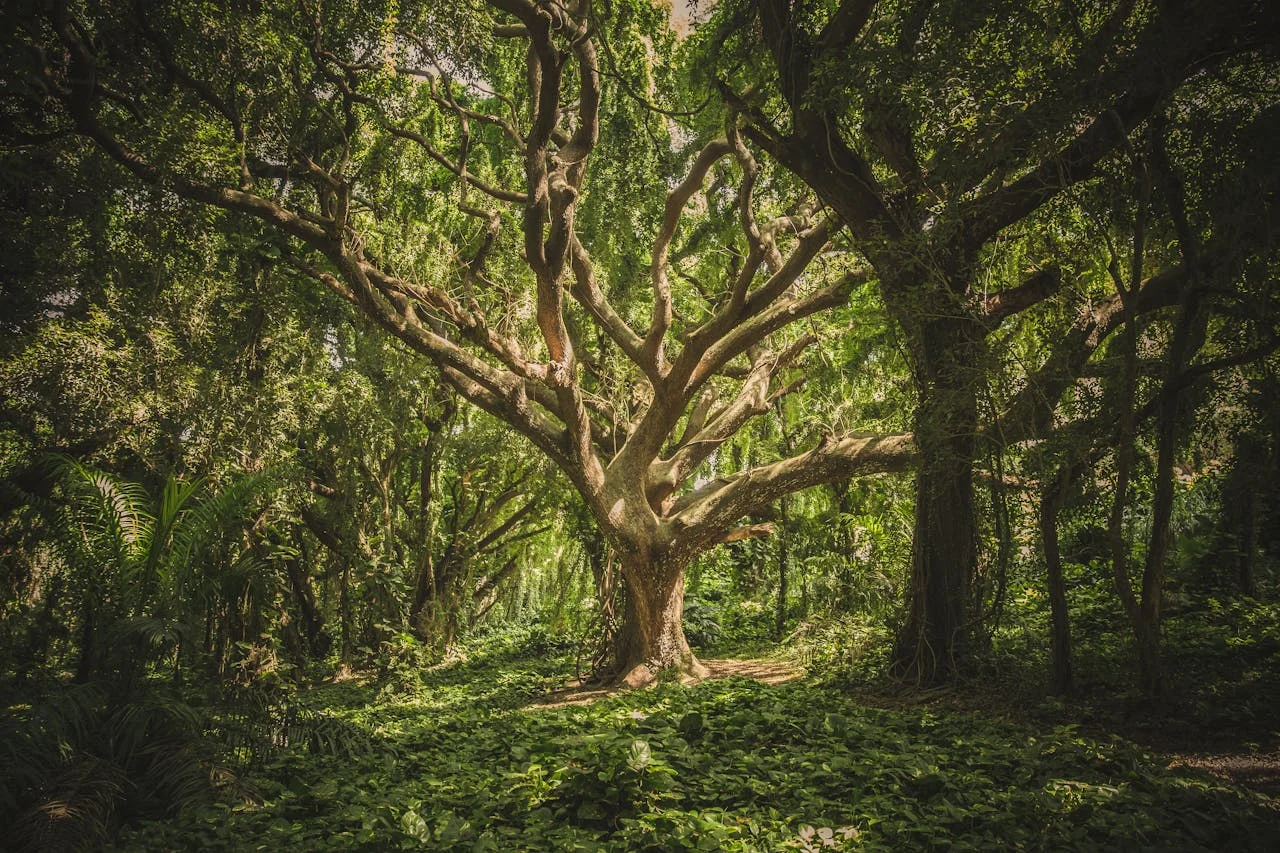
For centuries, trees were seen as solitary giants—rooted in place, competing silently for sunlight, water, and soil. Yet modern ecological research has revealed a very different picture. Beneath the forest floor lies a vast web of connections created by fungi, linking trees into complex communication and exchange systems.
Often described as the “wood wide web,” these underground fungal networks allow trees to share nutrients, send warning signals, and even nurture younger saplings.
The nature of mycorrhizal fungi
The communication among trees begins with their partnership with mycorrhizal fungi. These fungi colonize tree roots and extend into the soil as thread-like filaments called hyphae. In exchange for sugars produced by photosynthesis, the fungi provide trees with enhanced access to water and essential nutrients such as nitrogen and phosphorus. This symbiotic relationship, which has existed for hundreds of millions of years, forms the foundation of the underground networks that connect entire forests.
Creating underground networks
As the fungi grow, their hyphae spread outward, linking the roots of multiple trees together. This creates an interconnected system through which resources and information can flow. These networks often extend across large areas, weaving together trees of different species and ages. In effect, the fungal networks act as natural internet cables, facilitating exchanges that sustain the health and stability of the forest ecosystem.
Sharing nutrients across species
One of the most remarkable discoveries about fungal networks is their role in nutrient sharing. Through these underground links, older, more established trees can transfer carbon to younger or shaded saplings that struggle to photosynthesize. Similarly, trees of different species may exchange nitrogen or other minerals, balancing the needs of the community. This mutual support system challenges the traditional view of forests as purely competitive environments, highlighting instead a form of cooperation that enhances collective survival.
Defense signals against threats
Fungal networks also play a role in forest defense. When a tree is attacked by pests such as insects or pathogens, it can send chemical signals through the fungal threads to warn neighboring trees. These trees respond by boosting their own production of defensive compounds, such as tannins, which make their leaves less palatable to herbivores. This rapid communication enables forests to mount coordinated defenses, improving the resilience of the ecosystem against widespread threats.
The role of “mother trees”
Within these networks, certain large, mature trees—sometimes called “mother trees”—play a central role. Because they have deep root systems and abundant resources, they often serve as hubs, channeling nutrients and information to younger saplings. In some cases, mother trees have been observed sending carbon to their own offspring, enhancing the survival of the next generation. This nurturing role illustrates the depth of interconnectedness in forests and underscores the importance of protecting old-growth trees.
Competition alongside cooperation
While cooperation is a key feature of fungal networks, competition also exists. Trees may sometimes prioritize their own survival, limiting the flow of resources to others. In some cases, invasive plant species can exploit fungal networks, drawing nutrients without offering much in return. The underground system is therefore a dynamic balance of sharing and self-preservation, reflecting the complexity of ecological interactions rather than a purely altruistic model.
Types of mycorrhizal associations
Not all fungal networks function in the same way. Scientists identify two major types of mycorrhizal fungi:
- Ectomycorrhizal fungi – These form sheaths around tree roots and extend into the soil. They are common in temperate and boreal forests, often associated with trees like oaks, pines, and beeches.
- Arbuscular mycorrhizal fungi – These penetrate root cells directly and are more common in tropical and grassland ecosystems, connecting a wide range of plants.
Both types contribute to nutrient exchange and communication, but the structure and extent of the networks vary depending on ecosystem type.
Implications for forest resilience
The discovery of fungal communication networks has profound implications for forest management. Healthy networks improve the resilience of forests to climate stress, drought, and disease. When forests are fragmented or old-growth trees are removed, the integrity of these underground systems is disrupted, making ecosystems more vulnerable. Conservation strategies increasingly recognize the importance of preserving not only the visible canopy but also the hidden fungal infrastructure that sustains forest life.
Applications in agriculture
The principles of fungal networks are now being applied in agriculture. Farmers and researchers are exploring ways to enhance crop growth by encouraging mycorrhizal associations in fields. By reducing reliance on chemical fertilizers and fostering natural fungal partnerships, agriculture can become more sustainable and resilient. These practices reflect a growing awareness that the invisible connections beneath the soil are as vital as the plants that grow above it.
Cultural interpretations of forest communication
Interestingly, many Indigenous cultures have long described forests as interconnected, living communities, where trees and plants share life energy. Modern scientific discoveries about fungal networks echo these traditional understandings, providing empirical evidence for ideas that have been passed down through oral traditions. This convergence highlights how science and cultural wisdom can complement each other in deepening our appreciation of nature’s complexity.
Reimagining forests as communities
The revelation that trees communicate through underground fungal networks has transformed how we see forests. No longer are they static collections of competing individuals. Instead, they emerge as dynamic, interconnected communities bound together by shared resources and signals. The fungal networks beneath our feet are as vital to the forest as the sunlight above, weaving trees into intricate webs of life. By uncovering these hidden systems, science has not only expanded our ecological knowledge but also challenged us to rethink our relationship with the natural world.