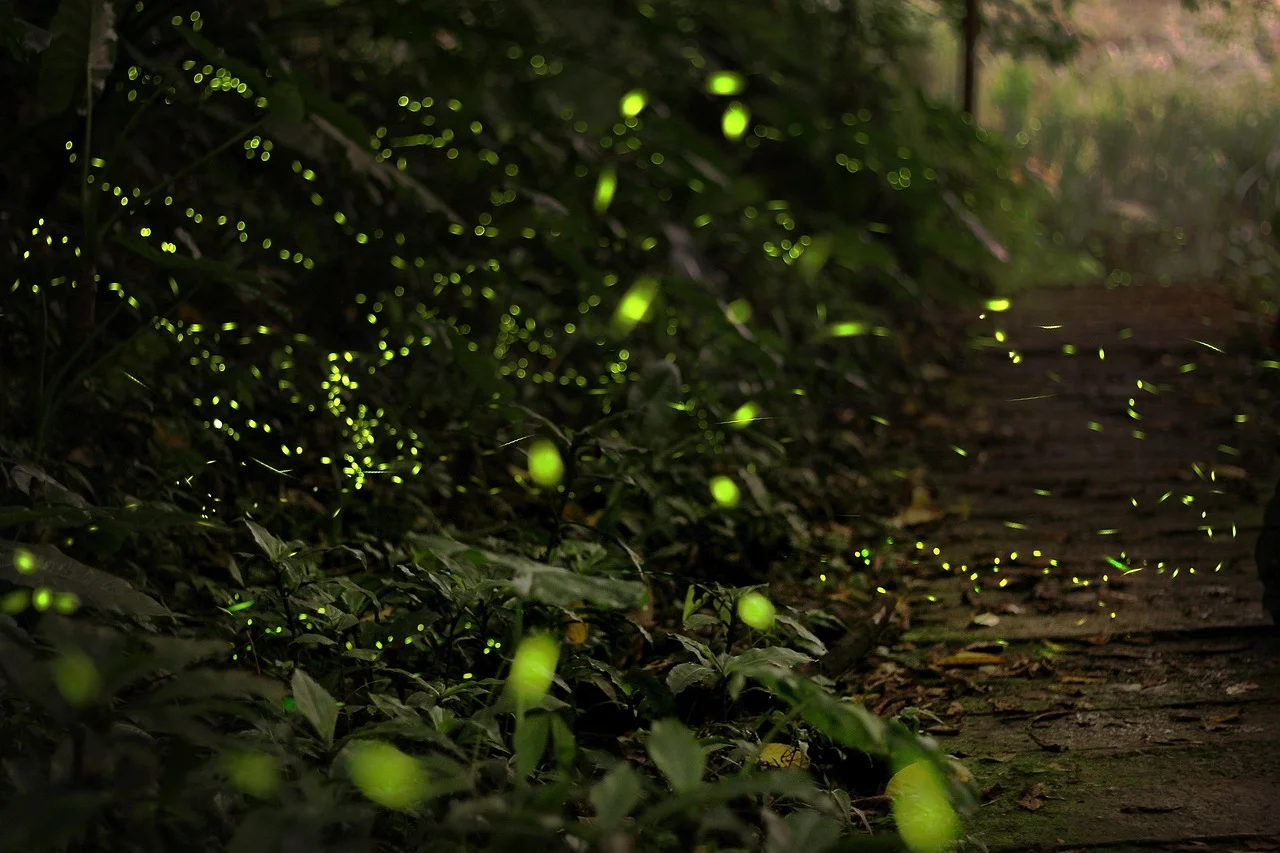
On warm summer evenings, the flickering glow of fireflies is one of nature’s most enchanting spectacles. These small beetles, also known as lightning bugs, produce light that appears magical to the human eye. Yet behind the beauty lies a complex biological process that scientists have studied for decades.
Unlike a candle flame or a light bulb, which emit both light and heat, fireflies generate their glow without producing noticeable warmth. This phenomenon, known as bioluminescence, is both efficient and purposeful. To understand how fireflies produce “cold light,” we need to explore the chemistry, physiology, and evolutionary advantages of their natural lanterns.
The basics of bioluminescence
Bioluminescence is the ability of living organisms to generate light through chemical reactions. It is found in many creatures, from deep-sea fish to certain fungi, but fireflies are among the most familiar examples on land. The light is produced in specialized organs located in the insect’s abdomen. These organs contain cells packed with enzymes and molecules that work together to generate illumination. What makes this process so remarkable is its efficiency: nearly all of the energy is converted into light, with less than 2% lost as heat.
The chemical reaction at work
At the heart of firefly bioluminescence is a chemical called luciferin. When luciferin combines with oxygen inside the light-producing cells, it interacts with an enzyme called luciferase. This reaction releases energy in the form of visible light. Magnesium ions and a molecule called adenosine triphosphate (ATP)—the universal energy currency of living cells—are also required to drive the process. The result is a glow that can range from yellow-green to pale orange, depending on the species of firefly.
The key to avoiding heat lies in the efficiency of this chemical pathway. In traditional combustion or electrical lighting, much of the energy dissipates as heat. Fireflies, by contrast, channel nearly all the released energy into visible photons, producing what scientists call “cold light.”
Control of the light switch
Fireflies do not glow constantly. They flash in rhythmic patterns that serve as signals to potential mates or warnings to predators. This control is possible because fireflies can regulate the oxygen flow into their light-emitting cells. When oxygen enters the cells, the luciferin-luciferase reaction is triggered and light appears. When the oxygen supply is cut off, the reaction stops. Specialized nerve impulses and nitric oxide signaling pathways play a role in controlling this on-and-off mechanism, giving fireflies the ability to create precise flashes.
Why light without heat matters
From an evolutionary standpoint, producing light without heat is advantageous. Generating unnecessary heat could damage delicate tissues, especially in small insects with limited ability to regulate body temperature. Heat production would also waste energy, reducing the efficiency of the signaling system. By producing cold light, fireflies conserve energy while ensuring their communication remains effective. This efficiency allows them to flash repeatedly without overheating or exhausting their energy reserves.
Communication and courtship
The primary purpose of firefly bioluminescence is communication, particularly during mating. Each firefly species has its own unique flashing pattern, which males use to signal females of the same kind. Females often respond with specific return flashes, enabling pairs to recognize one another even in the dark. Because the flashes are so energy-efficient, males can continue their courtship displays throughout the night without risk of overheating. This low-energy, low-heat signaling system ensures reproductive success in environments where visual cues must work under limited light.
Defense against predators
In addition to courtship, fireflies also use their light as a defensive tool. Many fireflies contain bitter-tasting chemicals that make them unappealing to predators such as birds or amphibians. The flashes act as warning signals, communicating that the insect is not a safe meal. This strategy, called aposematism, relies on the brightness and visibility of the cold light to deter attackers. Again, the efficiency of bioluminescence ensures that these signals can be displayed without imposing dangerous thermal costs on the insect.
The physics of cold light
To understand why firefly light does not generate heat, it helps to consider the physics of energy conversion. In typical light sources, such as an incandescent bulb, electrical energy excites atoms in a filament, releasing photons. However, this process also releases thermal energy because the atoms vibrate intensely. In contrast, the firefly’s chemical reaction directly produces excited molecules of oxyluciferin. When these molecules return to their ground state, they release energy solely as photons rather than heat. This direct conversion minimizes energy loss and explains the extraordinary efficiency of bioluminescence.
Comparisons with artificial lighting
The efficiency of firefly light has inspired scientists to compare it with human-made technologies. Traditional incandescent bulbs convert less than 10% of their energy into light, with the rest lost as heat. Fluorescent lights are better, but still not perfect. Light-emitting diodes (LEDs) come closest to the efficiency of bioluminescence, but even they cannot fully match the nearly 100% conversion seen in fireflies. This has led researchers to study luciferase enzymes in hopes of developing bio-inspired lighting or imaging technologies.
Medical and scientific applications
The luciferin-luciferase system in fireflies has also been harnessed for scientific research. By inserting the luciferase gene into other organisms, scientists can create glowing cells that reveal the activity of certain biological processes. This has become an invaluable tool in medical research, from tracking cancer cell growth to testing the effectiveness of new drugs. Because the reaction produces light without heat, it does not interfere with the normal function of the cells being studied, making it especially useful in delicate experiments.
Environmental influences on glow
The intensity and color of firefly light can vary depending on environmental factors. Humidity, temperature, and the availability of oxygen all influence how brightly a firefly glows. In some species, the emitted wavelength shifts slightly depending on these conditions, creating subtle variations in the glow. This adaptability highlights the evolutionary fine-tuning of the bioluminescent system, ensuring effective signaling in different habitats.
Firefly light as nature’s efficiency model
The glow of fireflies is more than a summer spectacle—it is an extraordinary example of natural efficiency. By producing light without heat, fireflies achieve a level of energy conversion that remains the envy of engineers and physicists. This adaptation serves vital roles in communication, reproduction, and defense, while simultaneously inspiring human technologies in medicine and sustainable lighting. In every flash, the firefly demonstrates how biology can achieve elegance and efficiency beyond the reach of most artificial systems.